July 6, 2026 · 4-minute read
Asian hornet: spring is the time to act
Vespa velutina works its way up through the Alpes-Maritimes every year. Destroying a nest in April costs ten times less than in July, and protects bees far…
The arrival of the Asian hornet on the French Riviera
Since its accidental introduction to France in 2004, Vespa velutina nigrithorax — the Asian hornet — has steadily colonised the south-east. On the French Riviera, the species is now firmly established at every altitude below 1,500 m: Monaco, Cap-d'Ail, Èze, La Turbie, Beausoleil and Roquebrune-Cap-Martin are all affected.
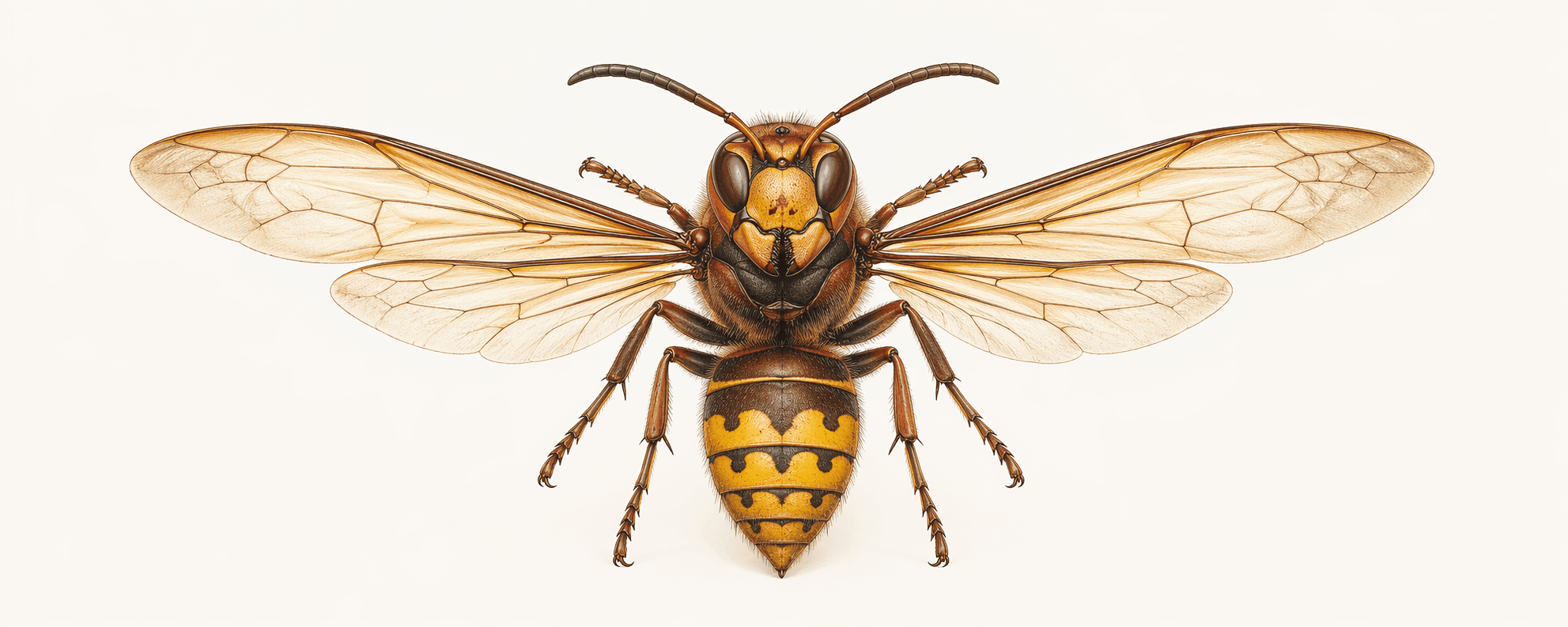
The Asian hornet can be identified by its black thorax, its predominantly black abdomen crossed by a narrow orange band, and its yellow-tipped legs. It is smaller than our European hornet Vespa crabro and almost always darker.
Why April is the right moment
A colony's annual cycle follows a precise timetable:
- March – April: the foundress (a queen that has overwintered alone) builds a primary nest, about the size of an orange, often at head height, in a sheltered spot (garden shed, window frame, under a roof). She alone defends it.
- May – June: the first workers emerge. The nest grows. It is often abandoned in favour of a secondary nest, much higher up in a tree or in a roof structure.
- July – September: the colony reaches several thousand individuals. The secondary nest can be as large as a basketball or bigger.
- October – November: the future foundresses leave the nest to overwinter. The nest empties out.
Destroying a primary nest in April is fast, inexpensive, carries no risk from an aggressive colony, and removes a future colony of several thousand individuals. Destroying a secondary nest in July, high up, on an active colony means a full-suit intervention with a telescopic pole, sometimes at night, at a far higher cost.
What to do if you spot a primary nest
- Do not try to remove it yourself. Even on her own, the Asian hornet defends her nest. The sting is no more toxic than a wasp's for most people, but it is extremely painful — and multiple stings can trigger anaphylactic shock in anyone who is allergic.
- Photograph it from a safe distance and record its exact location (height, access, whether children or animals are nearby).
- Call a Certibiocide-certified professional. In Monaco and the Alpes-Maritimes, this is a regulated intervention: we work with a telescopic pole, inject an approved biocide into the heart of the nest, then remove the nest at D+7 to prevent any late returning workers from re-establishing.
And what about the bees?
Vespa velutina is a formidable predator of honeybees: a single colony can wipe out an apiary within a few weeks, hovering in front of hives to intercept returning foragers. Destroying a primary nest in April means saving tens of thousands of bees that the colony would otherwise have consumed over the summer.
*Have you spotted a nest in Monaco, Cap-d'Ail, Beausoleil or the surrounding area? Report it to us — we intervene quickly, and an April bill bears no comparison to a July one.*
The questions our clients ask most often
How long does the intervention take? On average, 90 minutes for an audit plus 2 to 4 hours for a standard treatment in a flat or villa. For complex sites (palace hotels, restaurants in operation, multi-block condominiums), the intervention may be spread across several night slots to respect your business hours. The schedule is always agreed in advance, never imposed.
Can premises be reoccupied quickly? For the vast majority of our treatments (bait gel, dry steam, mechanical placement), reoccupation is immediate or after 1 to 2 hours of ventilation. For approved residual treatments, we always specify the recommended waiting time (typically 2 to 4 hours). For aerosol biocides, the waiting time extends to 6 hours and we provide a formal reoccupation certificate.
What legal documents and certificates do you issue after the intervention? After each intervention, you automatically receive in your client area a signed digital report with before/after photos, a treatment certificate valid for audits, safety commissions and insurers, and an updated register of the biocides applied (exportable on request to the French and Monégasque health authorities).
Is there any follow-up after the intervention? Yes, systematically. Depending on the service, we schedule a follow-up visit at D+7, D+14 or D+21, according to the biological cycle of the species treated. For 360° monitoring contracts, follow-up is continuous, with quarterly reports and immediate interventions whenever you flag an issue.
The cost compared to inaction
An infestation left unaddressed typically costs ten times more in curative treatment than in a preventive programme. A few concrete examples from the French Riviera:
- An Asian hornet primary nest destroyed in April:à chiffrer–250. The same nest once it has become a secondary nest (August):à chiffrer–1,200. The same colony wiping out a neighbouring apiary: several thousand euros in beekeeping losses plus biodiversity damage.
- A palace-hotel room closed for 72 hours for bed bug treatment in peak season:à chiffrer,400 in lost revenue plus reputational damage. The same incident caught pre-season:à chiffrer in treatment, zero operational impact.
- A premium gastronomic restaurant kitchen shut down for 5 days by a safety commission over cockroaches: >sur devis,000 in lost revenue plus a risk of HACCP downgrade. An annual 360° contract:à chiffrer,800–3,500.
- A condominium that discovers an advanced longhorn beetle infestation:à chiffrer,000–50,000 in repair works plus curative treatment. A preventive acoustic diagnosis every 5 years:à chiffrer per visit.
The rule is universal: the audit always costs less than the repair.
Our environmental commitment
Every one of our protocols is designed to minimise the impact on Mediterranean biodiversity. In practical terms, that means: refusing routine preventive spraying, selecting the biocides with the most favourable environmental profile in their category, prioritising mechanical and biological methods whenever available, protecting non-target species (bees, geckos, hedgehogs, insectivorous birds, bats), and maintaining an exportable register of biocides applied for the authorities.
We are also committed to explaining these choices to our clients. Integrated pest management is not a marketing slogan — it is a discipline that demands proper time for diagnosis and explanation. On sites where a request for "preventive spraying without diagnosis" is put forward, we systematically propose an alternative: monitoring, audit, targeted treatment on zones of proven risk.
For professionals: regulatory compliance
Our documentation is designed to streamline audits by your quality partners. Our intervention reports meet the standards of the international hotel rankings, the independent luxury hotel alliances, the high-end hotel groups and hôtels de luxe indépendants in hospitality, and align with third-party certification bodies and an environmental certification body audits in food service and the agri-food industry. The biocide register complies with the French decree of 28 June 2017 and European the European framework on professional biocides.
For charter yachts, our documentation is translated into English and accepted by the leading management companies (the leading yacht management groups, the leading yacht management groups, the leading yacht management groups). Contractual NDA as standard. No establishment name, owner name or yacht name ever appears in our external communications.
A high-end service culture
Our technicians come from five-star hospitality, yachting and luxury hotel service. This culture of discretion and premium service is our signature. No resident guest should ever see a technician in a "pest control" uniform. No identifying photograph ever leaves our secure perimeter. No yacht name, no client name, no identifying detail appears in our external communications.
This stance is not a commercial argument — it is a contractual obligation to our high-end clientele. And it is the same standard we apply to private clients, because premium service is defined by its consistency, not by its occasional appearance.
A practical checklist to print out
For professionals who want to run the first line of defence themselves, here is a 10-point checklist to apply every month on your site, with a single goal: detect as early as possible — before an infestation becomes visible and expensive:
- Visual inspection of mattress seams in 2 rooms chosen at random on each floor (5 minutes per room).
- Check the door seals on cold rooms in the kitchen. Any damaged seal must be replaced immediately.
- Check the skirting boards at the foot of the beds and the power sockets on the bedside side. Photograph any anomaly.
- Inspect the laundry bags in the linen room. Laundry must never be left open for more than 4 hours.
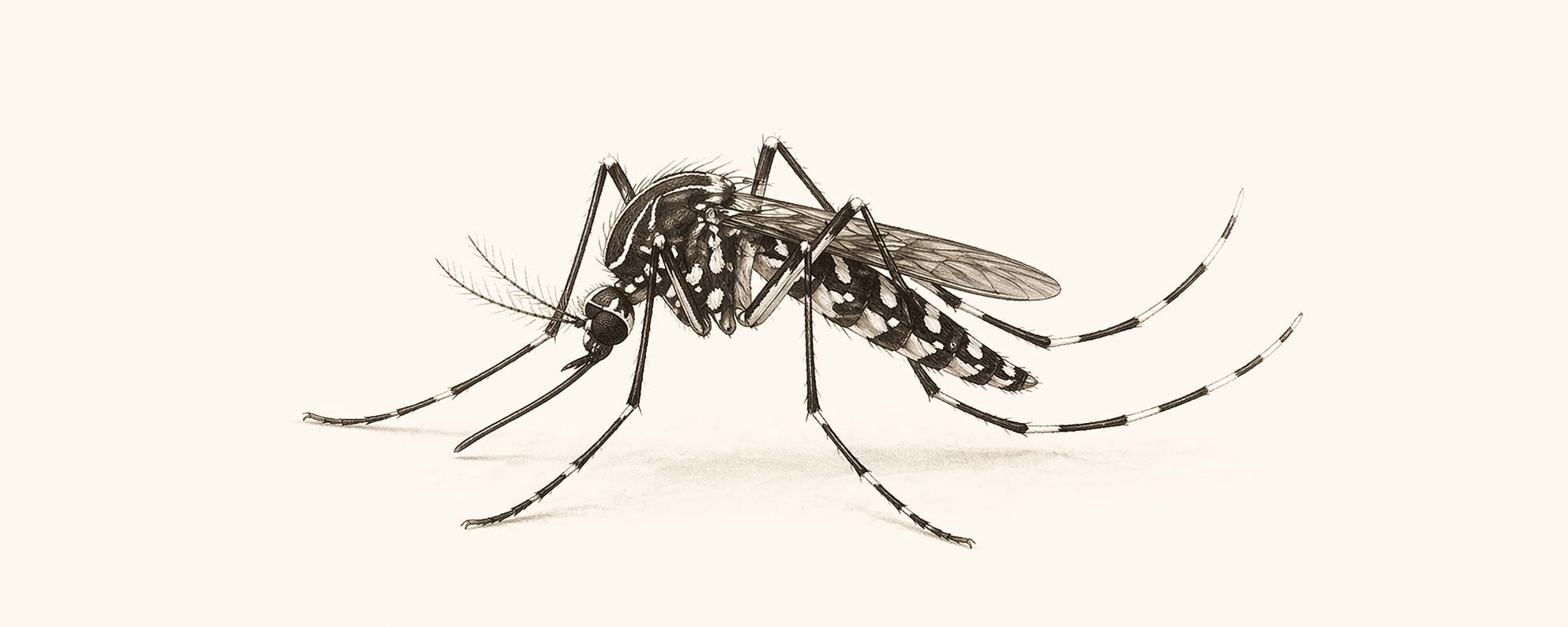
- Audit plant-pot saucers on terraces and balconies (tiger mosquito larval breeding sites). Empty weekly.
- Check gutters and rainwater downpipes. Any blockage creates a breeding site.
- Inspect technical areas (boiler rooms, refuse rooms, crawl spaces). Look out for any trace of droppings.
- Check the condition of installed bait stations. Station number, photograph and inspection date.
- Inspect attics, green roofs and roof access. Spot primary hornet nests before June.
- Monthly briefing for department heads: one sign spotted in time is worth a thousand curative interventions.
Contact us to go further
For clients on a 360° contract, this checklist is built into your client dashboard and automatically feeds your quarterly report. For one-off clients, we offer, on request, a one-hour on-site training session for your housekeepers, department heads or in-house technicians — free of charge for clients on an annual contract.
Every contract includes 24/7 access to our proprietary digital platform, where you can retrieve at any moment the full history of your interventions, before/after photos, treatment certificates, biocide register and safety data sheets (SDS) for the products used. Documents can be downloaded as many times as needed for your audits, safety commissions and insurers.
For emergencies (hornets near a terrace, suspected bed bugs in an open hotel, cockroaches in a professional kitchen), we commit to a swift callback, seven days a week, with rapid on-site intervention.