
September 23, 2026 · 4-minute read
Asian hornet: find the primary nest in your garden before June
Sheds, eaves, utility boxes: a simple method to grid-search your garden and spot the Asian hornet's primary nest before summer arrives.
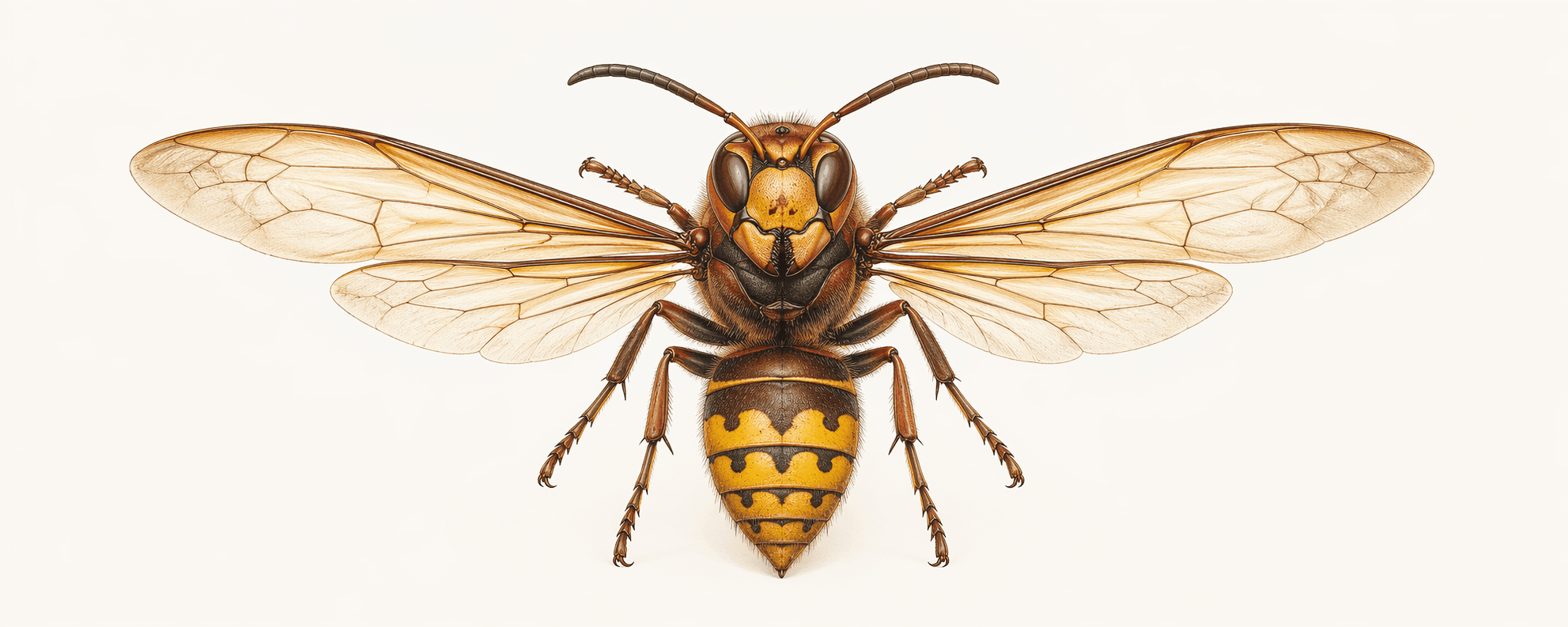
Every Asian hornet nest starts small. In spring, a founding queen that has come out of hibernation builds a primary nest on her own, first the size of a ping-pong ball, then of an orange, in a sheltered spot that is often close to houses. Once the first workers have emerged, the colony grows quickly and may build a secondary nest, much larger and often perched at the top of a tree.
Finding the primary nest before June means acting while the colony is still small and within reach. Here is a simple method for inspecting your garden systematically, without taking any risks.
The Asian hornet calendar at a glance
- Late winter and spring: founding queens leave their winter shelter, often as early as March on the coast, and build the primary nest alone.
- Spring and early summer: the first workers take over and the colony develops rapidly.
- Summer and autumn: many colonies move into a secondary nest high up; this is the period of attacks on beehives and of stings.
- Late autumn: the future queens leave the nest to overwinter; the abandoned nest will not be reused.
If you are reading this in autumn, falling leaves often reveal secondary nests that are now empty: keep the method below for next spring.
Where a primary nest hides
The founding queen looks for a dry shelter, protected from rain and wind, often at a low height. Inspect these places first:
- sheds, garden huts, garages and pool houses: ceilings, shelves, the underside of workbenches;
- soffits, eaves, pergolas and the underside of balconies;
- roller-shutter boxes and letterboxes;
- utility boxes: meters, pool filtration rooms, irrigation chambers, electrical cabinets;
- stored garden furniture, closed parasols, barbecue covers;
- dense hedges and shrubs clipped into balls.
The grid method, zone by zone
Rather than wandering around the garden at random, divide it into zones and always inspect them in the same order. A round of about a quarter of an hour, once a week from March to June, is a good rhythm for a medium-sized garden.
- Draw a rough plan of the grounds and number the zones: façades, visible roof, outbuildings, pool surroundings, hedges, the far end of the garden.
- Start with the house: look up at the eaves and sheltered corners, with binoculars if needed.
- Move on to the outbuildings: open the doors slowly and shine a torch on ceilings and shelves, without moving anything abruptly.
- Check boxes and furniture: lift lids with a long-handled tool rather than by hand.
- Finish with the vegetation: look at the hedges from a distance, searching for a small beige or greyish ball with a papier-mâché look, open at the bottom.
- Watch for comings and goings: a hornet that keeps returning to the same spot often gives away a nest nearby.
- Tick off each zone on your plan and date your round.
Identifying the insect correctly
The Asian hornet can be recognised by its dark body, an abdomen marked with a single broad yellow-orange band, and legs that are yellow at the tips. The European hornet, which is bigger, is reddish-brown and yellow; wasps, which are smaller, are striped yellow and black. If in doubt, a photo taken from a distance makes identification easier: see our guide European or Asian hornet.
What you must not do
- touch the nest, shake it or spray it with a hose;
- use an insecticide spray, fire or a makeshift plug over the entrance;
- let children and pets come near: instead, cordon off the area from a distance;
- set up non-selective homemade traps, which mostly catch other insects, including pollinators.
Even a small occupied nest can cause stings, which are dangerous in case of allergy or multiple stings. If someone shows signs of an allergic reaction, call the emergency services immediately.
You have found a nest: what to do next
Photograph it from a distance, mark its location on your plan and call us. An occupied nest is one of the immediate-risk situations covered by our 24/7 on-call service, triggered after a first phone call: we call you back within 6 hours, 7 days a week. Our Certibiocide-certified technicians neutralise the nest with approved biocidal products, while respecting your pets and the biodiversity of your garden. The intervention report, electronically signed with photos, is then available in your client area. To find out more, see our Asian hornet page and our article on the primary nest in April.
Unsure about your garden? Let's talk
A villa in Èze, a garden in Beaulieu-sur-Mer or a terrace in Monaco: if you spot a nest or suspicious comings and goings, send us a photo on WhatsApp at the number below, or call us directly.
Request your free quote or call +377 37 70 70 02: reply within 6 hours.
Frequently asked questions
- What does a primary Asian hornet nest look like?
- It is a small beige or greyish ball with a papier-mâché look, ranging from the size of a ping-pong ball to that of an orange, open at the bottom. It is often found in a garden shed, under the eaves or in a utility box.
- Can I destroy a primary nest myself?
- We advise against it: even a small occupied nest can cause stings, and if the queen escapes, she may rebuild elsewhere. Photograph it from a distance and call in a professional.
- What should I do if I find an occupied nest in my garden?
- Keep children and pets away, cordon off the area from a distance and call +377 37 70 70 02: an occupied nest triggers our 24/7 on-call service, with a call back within 6 hours, 7 days a week.