July 21, 2026 · 13-minute read
Secondary Asian hornet nest in July: high-reach intervention on the Riviera
In July and August, Asian hornets abandon their primary nest for a secondary nest high up, as large as a basketball. Telescopic lance up to 20 metres, full-body protection, night-time intervention and bee protection: the complete method for summer nest removal.
Secondary nest or primary nest: two entirely different worlds
Many property owners along the Riviera first discover the Asian hornet in the middle of summer, when a dark mass suddenly appears in a garden tree or under a roof structure. What they are looking at is almost never the colony's first nest, but its secondary nest. Understanding the difference between a primary and a secondary nest is the first key to grasping why a summer intervention calls for genuinely specialised expertise.
The primary nest is built in spring by a single founding queen emerging from hibernation. It is small, often the size of an orange, rarely larger than a grapefruit. It is found in sheltered, low places: a garden shed, a windowsill, an outbuilding, a doorframe, sometimes even a letterbox. At this stage the colony has only a handful of members and the queen still does much of the work herself. This is the ideal moment to act, but also when the nest most easily goes unnoticed.
As the colony grows, the primary nest becomes too cramped. The increasingly numerous workers abandon this first shelter to build a secondary nest, usually high up. This is the spectacular nest that reaches the size of a basketball, or larger: some late-season constructions exceed sixty or eighty centimetres in diameter. It is most often perched at the top of a tree — a cypress, an oak, a plane tree — or attached beneath a roof frame, an eave or a cornice. Between the orange of spring and the basketball of summer, the population has multiplied by a considerable factor: from a few dozen individuals to several thousand.
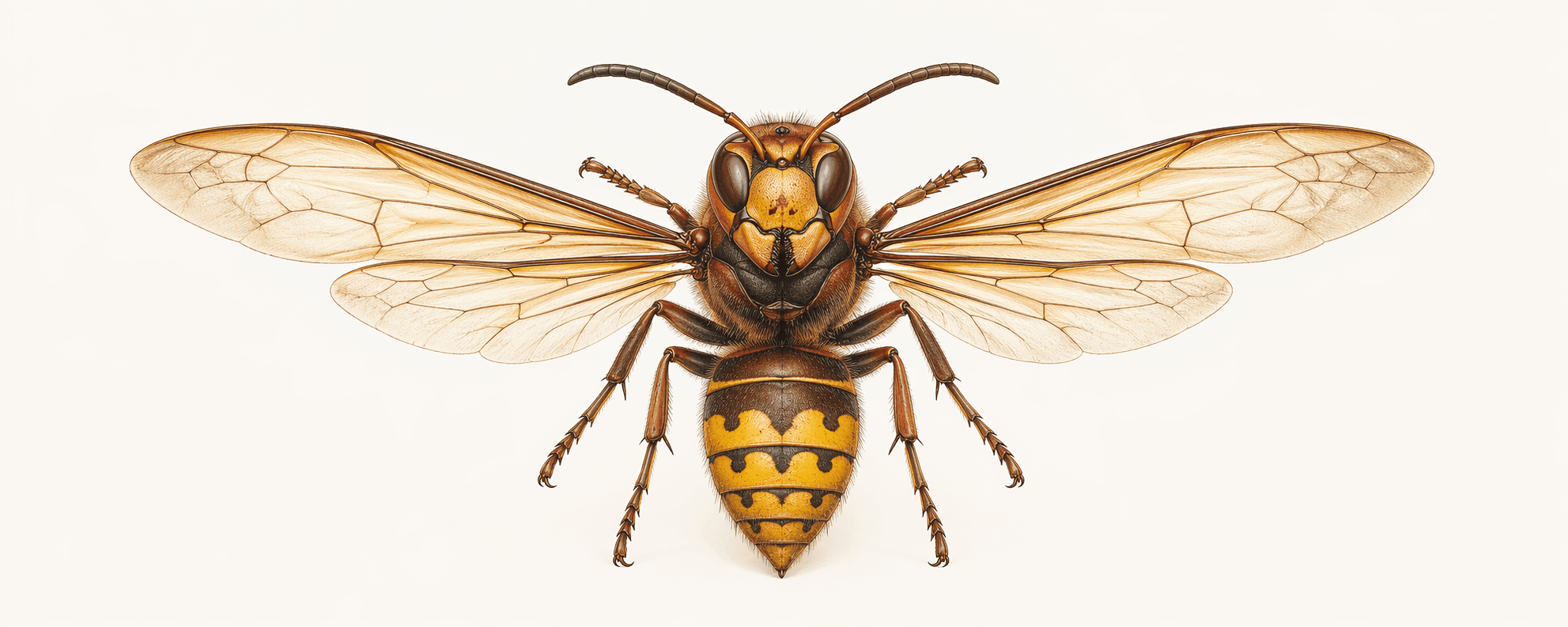
This shift changes everything about the intervention. A low primary nest is treated quickly and with little risk. A secondary nest perched at ten, fifteen or twenty metres, sheltering thousands of hornets in full defence of their brood, demands specific equipment, a rigorous method and full-body protection. For a detailed understanding of the species' biology, our dedicated page on Asian hornets sets out the colony's complete life cycle.
Why July and August mark the peak of activity
If so many secondary nests are discovered in high summer along the coast, it is no accident. The colony's cycle follows a very marked curve, and July-August corresponds precisely to the moment when the population reaches its maximum visible expansion.
In spring, the queen founds her colony alone. For several weeks, growth remains slow: each worker must first be born, mature, then help rear the next generation. It is exponential progress, but starting from a very low base. Only from late June, and above all in July, does the snowball effect become spectacular. Hundreds of workers are now available to enlarge the nest, hunt and feed an ever-larger brood.
The Riviera climate amplifies this. Long, mild summers, an abundance of prey — bees, flies, wasps, garden insects — and plentiful ripe fruit give colonies ideal development conditions. Heat speeds up larval metabolism and shortens egg-laying cycles. A colony that would plateau in a harsher climate keeps growing here right into autumn.
July and August are also the months of most intense hunting activity. Hornets must feed a maximum number of larvae, which multiplies their comings and goings and makes the nest very visible: a continuous ballet of insects around a fixed point high up almost always betrays an active secondary nest. It is often this movement, more than the nest itself, that residents notice first.
This peak period unfortunately coincides with when gardens are most in use: meals on the terrace, children playing, hedge and tree maintenance. The risk of an encounter therefore rises mechanically. A rapid intervention is not merely a matter of comfort; it prevents accidents. When a nest is discovered in high season, our 24/7 emergency service allows immediate response.
Height, the obstacle that changes everything: up to 20 metres with the telescopic lance
The real challenge of the summer secondary nest comes down to one word: height. A nest attached to the top of a tall tree or under a high cornice cannot be treated like a nest reachable from the ground. This is where technique makes all the difference.
Our method relies on a telescopic treatment lance able to reach the nest up to twenty metres high, without a cherry picker, without an unstable ladder and without hazardous climbing. This high-reach capability is at the heart of our expertise on the Riviera, where large ornamental trees, century-old cypresses and the high roof structures of villas make so many nests inaccessible by ordinary means.
The telescopic lance allows a treatment product to be injected directly into the heart of the nest, at the entrance, where the colony concentrates. The operator stays on the ground, at a safe distance, and targets the nest with precision. The principle is simple but demanding: the product must penetrate the nest to reach the hornets inside, including the queen, otherwise the colony would rebuild. A simple external spray — or worse, an attempt to knock down the nest without prior treatment — would only scatter a swarm of aggressive hornets without neutralising the colony.
This approach offers a double advantage. First, safety: the operator does not need to be exposed in the immediate vicinity of the nest, which considerably reduces the risk of mass stings. Second, effectiveness: the treatment reaches the nest in its real configuration, without disturbing it prematurely. Any removal of the empty nest happens only afterwards, once the colony has been neutralised.
This high-reach speciality is the subject of a detailed account in our article on high-level nest treatment with a lance up to 20 metres, which concretely illustrates several situations encountered at coastal villas. To assess your particular situation, a free quote helps define the approach suited to your grounds.
Full-body protection: why it is non-negotiable
Working on a secondary nest of several thousand hornets demands flawless protection. The full-body protective suit is not a comfort accessory; it is the very condition of the operator's safety.
The Asian hornet defends its nest with formidable determination. Contrary to a common belief, it does not attack people at a distance without reason, but it becomes extremely aggressive as soon as the nest is threatened or vibrates. And any intervention, however careful, triggers a defensive reaction. The hornets then pour out in numbers and seek to sting. Their stinger, longer than a wasp's, can pierce ordinary clothing and inject a significant dose of venom. Multiple stings are dangerous for everyone and potentially serious for allergic people.
The operator's full-body suit combines several layers: a thick coverall specially designed to resist stingers, a protective face veil that keeps a gap between fabric and skin, reinforced gloves and protection at the wrists and ankles, the classic entry points. The whole is designed so that no hornet can reach the skin, even during a mass attack.
This full protection, combined with remote intervention via the telescopic lance, forms a coherent system. The lance keeps the operator away from the nest; the suit protects against individuals that still manage to get close. It is this double barrier that makes it possible to safely treat nests that no one should ever approach without equipment. Any amateur attempt, on a ladder, in ordinary garden clothes, exposes the person to real danger and must be absolutely avoided. When in doubt, it is far better to call our 24/7 emergency service than to risk an accident.
The night-time intervention: the window when aggression falls to a minimum
The choice of intervention timing is as decisive as the equipment. Whenever the configuration allows, we favour a night-time or dusk intervention, for a precise reason: this is when the colony's aggression is reduced to a minimum.
The Asian hornet is a diurnal insect. It hunts and is active during the day and returns to the nest at nightfall. At night, almost the entire colony is present inside the nest, gathered together and barely mobile. This is a decisive advantage: treating a nest at night means treating the whole colony, including the hunting workers that would be absent by day. This avoids the scenario where dozens of hornets returning later rebuild activity around a poorly neutralised nest.
Darkness also sharply reduces the hornets' reactivity. Their vision is less effective at night, and their ability to locate and pursue a target diminishes. A colony that in broad daylight would defend itself with extreme violence stays far more passive in the dark. This does not mean the risk disappears — full-body protection remains essential — but the operator works in markedly safer conditions, with a less dense and less accurate defensive swarm.
This night-time approach illustrates a fundamental philosophy: minimising aggression, both for the operator and for the immediate environment. By intervening when the colony is calmest, we limit the dispersal of aggressive hornets into the garden, protect residents and pets, and increase the success rate of the treatment on the very first intervention. This demand for precision is found in every job described in our account of high-level nests.
Protecting bees: the real environmental stake
Treating an Asian hornet nest is not an ecologically trivial act, and that is precisely why the method matters as much as the result. The Asian hornet is itself a fearsome predator of bees: a single colony can decimate several hives by stationing itself in front of the entrances to capture foragers. On the Riviera, where hobby and professional beekeeping are alive and well, the pressure hornets place on bee colonies is a genuine concern.
Neutralising a hornet nest therefore contributes, indirectly, to protecting bees in the area. But the treatment itself must not harm pollinators. This is a central point of vigilance in our method. The treatment targets the nest exclusively, by direct injection inside, with no wide dispersal of product into the environment. Unlike a blind spray that would contaminate flowers and water points frequented by bees, targeted injection concentrates the product where it must act: at the heart of the hornet colony.
The night-time intervention further reinforces this protection. At night, bees are back in their hives and are not foraging. Treating at this time eliminates any risk of accidental contact between the product and active pollinators. Once the nest is neutralised, its removal prevents it from becoming a source of residual contamination.
This approach is part of a logic of responsible treatment: acting on the pest without turning the remedy into a problem. Protecting bees is not a side constraint; it is a component of quality work. A well-conducted treatment must solve the hornet problem while respecting the balance of the garden and the neighbourhood. For any situation involving nearby hives, it is useful to mention it when requesting a free quote, so that the protocol can be adapted accordingly.
Field experience: high gardens and villas on the Riviera
The particular features of coastal buildings and vegetation create situations rarely met elsewhere. Villa gardens, with their large ornamental specimens — slender cypresses, umbrella pines, holm oaks, palms — offer hornets ideal supports for installing a secondary nest out of reach. Add to this the high roof structures, cornices, eaves and lofts of these residences, all high-up refuges.
A typical summer case: a nest discovered at the top of a tall cypress at the back of a garden, some fifteen metres up, signalled by continuous coming and going above the terrace. The nest, invisible from the house because of the foliage, had been spotted only thanks to that insect movement. This kind of configuration perfectly illustrates the value of the telescopic lance: no cherry picker could reach the back of the sloping garden, and climbing would have been extremely dangerous. Treatment from the ground, at night, neutralised the colony without risk.
Another frequent situation: a nest lodged under a villa's eave, at top-floor height, above a very busy entrance or terrace. Here the stake is not only the height but the immediate proximity to the occupants. Every passing day increases the sting risk, particularly for children and animals. Speed of response then becomes the priority, which our 24/7 emergency service provides.
These field accounts share one point in common: they show that no high nest should ever be treated through improvisation. The combination of a sloping site, dense vegetation, significant height and a large colony creates a stack of difficulties that only suitable equipment and a proven method can overcome. This is the whole point of our specialisation, detailed in the article on high-level nests with a lance.
Our intervention protocol, step by step
A successful intervention is not improvised: it follows a precise protocol designed to maximise effectiveness while minimising risk. Each step has its reason for being.
The first step is always the diagnosis. Before any treatment, the nest must be precisely located, its height, size and accessibility assessed, the obstacles identified — foliage, cables, structures — and the residents' movement zones noted. This diagnosis determines the equipment to deploy, the lance's approach angle and the optimal intervention timing. A rushed diagnosis leads to ineffective treatment; a careful one guarantees neutralisation in a single intervention.
The second step is preparation: securing the area, keeping people and animals away, deploying the telescopic lance and putting on the full-body protective suit. The operator checks the firing angle, the trajectory towards the nest entrance and their own positioning at a safe distance.
The third step is the treatment itself: targeted injection of product into the heart of the nest, preferably at night or dusk, when the colony is gathered and barely reactive. The product must reach the inside of the nest to neutralise the entire colony, queen included.
The fourth step, often neglected by amateur approaches, is control and removal. Once the colony is neutralised, the empty nest can be taken down where possible and relevant, notably to prevent it from remaining as a landmark or a source of contamination. Removal also visually confirms the treatment's success. For each situation, a free quote specifies all these steps in advance, adapted to your configuration.
Certibiocide and professional framework: the guarantee of compliant treatment
Treating hornet nests involves biocidal products whose professional use is regulated. This framework is not a formality: it ensures the operator masters the products, their dosage, their conditions of use and the precautions required for the safety of people, animals and the environment.
Our interventions are carried out under certibiocide N°121134, which attests to training and authorisation for the professional use of biocidal products. This certification requires precise knowledge of the substances used, their effects and the associated protective measures. It is the mark of treatment carried out to professional standards, as opposed to the improvised solutions sold to the general public, often ineffective on a nest of several thousand individuals and potentially dangerous for the user.
This professional framework translates concretely into traceability: each intervention is documented, from diagnosis to final check. Respecting dosages and conditions of use guarantees a treatment that is both effective on the colony and respectful of the immediate environment, pollinators included. Choosing a certified intervention means ensuring the problem is dealt with properly, once, under controlled conditions, without transferring the risk to the environment or to other occupants. To learn the precise terms of an intervention on your property, requesting a free quote is the simplest starting point, and our dedicated page on Asian hornets gathers the essential useful information.
In summary: act fast, act well, act safely
The Asian hornet's secondary nest in July-August concentrates every difficulty: a maximum population of several thousand individuals, a high and often inaccessible location, formidable defensive aggression and proximity to heavily used gardens. Responding to it requires specific equipment — the telescopic lance up to twenty metres — full-body protection, a night-time intervention to minimise aggression, and a method that respects bees and the environment.
Faced with a nest discovered high up, the best decision is not to approach it and to call on a certified professional intervention. Our 24/7 emergency service handles the most pressing situations, and a free quote allows the approach suited to your grounds to be defined with peace of mind.
Zones served in Monaco and on the Riviera
We operate in particular on Fontvieille and Larvotto.
Frequently asked questions
- How do you tell a primary nest from a secondary Asian hornet nest?
- The primary nest, built in spring by the queen, is small — the size of an orange — and placed low, in a sheltered spot such as a garden shed or windowsill. The secondary nest, built in summer as the colony grows, reaches the size of a basketball and is high up, often at the top of a tree or under a roof structure. Between the two, the population multiplies by a considerable factor, going from a few dozen to several thousand individuals.
- Why are hornet nests mostly discovered in July and August?
- The colony's cycle follows exponential growth that reaches its visible maximum in high summer. In spring the queen founds the nest alone and progress is slow; from July, hundreds of workers rapidly enlarge the secondary nest. The long, mild Riviera climate and the abundance of prey and fruit speed up development. Intense hunting activity then makes the nest very visible through the hornets' continuous coming and going.
- Can a nest at 20 metres really be treated?
- Yes. Our method relies on a telescopic treatment lance able to reach the nest up to twenty metres, without a cherry picker or ladder. The product is injected directly into the heart of the nest from the ground, neutralising the whole colony, queen included, while keeping the operator at a safe distance. This high-reach capability is essential on the Riviera, where large trees and high roof structures make so many nests otherwise inaccessible.
- Why intervene at night rather than during the day?
- The Asian hornet is diurnal: at night, almost the entire colony has returned to the nest, gathered together and barely mobile. Treating at night therefore neutralises the whole colony, including the foragers absent by day. Darkness also sharply reduces the hornets' reactivity and aggression, making the intervention far safer. It is the best time to maximise effectiveness and minimise aggression.
- Is the treatment dangerous for garden bees?
- Our method is designed to protect pollinators. The product is injected directly into the nest, without wide dispersal into the environment, unlike a blind spray. The night-time intervention, when bees are back in their hives, eliminates any risk of accidental contact. Neutralising a hornet nest actually protects bees indirectly, since the Asian hornet is a fearsome predator of bee colonies.
- Should I call a certified professional or can I act myself?
- A high secondary nest of several thousand hornets must never be treated by an amateur: the risk of multiple stings is real and potentially serious. Our interventions are carried out under certibiocide N°121134, which guarantees mastery of the products, dosages and precautions. This certification ensures effective, compliant and environmentally respectful treatment, where consumer solutions are often ineffective and dangerous.