July 19, 2026 · 11-minute read
European vs Asian Hornet: How to Tell Them Apart — Monaco
Vespa velutina or Vespa crabro? Size, colour, behaviour and nest: the complete guide to telling the Asian and European hornet apart before any action.
On the Riviera, two insects carry the name "hornet" and trigger the same surge of anxiety when they circle a terrace: the European hornet (Vespa crabro) and the Asian hornet (Vespa velutina). Yet these two species share neither the same behaviour, nor the same environmental impact, nor the same way of nesting. Confusing them means risking the destruction of a useful colony, or on the contrary underestimating a real threat to honeybees and to the peace of a garden. This detailed guide teaches you to recognise each hornet at a glance, to understand what truly sets them apart, and to know when — and why — professional intervention becomes necessary.
Why identifying correctly before acting changes everything
The first and most common mistake is to treat any large flying insect as an enemy. In the field, we regularly see homeowners panic at a harmless European hornet, or conversely ignore for weeks the start of an Asian hornet colony that is visibly growing. Correct identification determines everything: the real level of risk, the urgency of intervention, the method used, and even whether one should intervene at all.
The European hornet is a native species, always present in our regions, rather peaceful and playing an ecological role in regulating insects. The Asian hornet, by contrast, is an introduced, invasive species whose spread along the Mediterranean coast poses a genuine problem for honeybee colonies and beekeeping. Confusing the two risks an unnecessary act or a damaging delay. That is why, before any quote and any intervention, we systematically request a rigorous identification — often from a simple photo. You can send us your images through our free quote request for a first remote assessment.
It must also be recalled that fear is a poor adviser. A low buzz and a heavy flight are often enough to trigger a disproportionate reaction, whereas the vast majority of insects approaching a terrace pose no danger as long as they are not provoked. Taking thirty seconds to calmly observe the colour, the size and above all the way of flying avoids many rushed decisions. It is this discipline of observation, more than any product, that makes the difference between calm management and costly panic.
Vespa velutina versus Vespa crabro: the ID card
Let us start by laying out the essential markers in a comparison table. Memorised once and for all, these criteria settle the vast majority of cases.
| Criterion | Asian hornet (Vespa velutina) | European hornet (Vespa crabro) | | --- | --- | --- | | Worker size | 17 to 32 mm, slender silhouette | 25 to 35 mm, bulkier insect | | Dominant colour | Very dark body, almost black | Brown-red and bright yellow, "giant wasp" look | | Abdominal bands | A single broad orange band, thin yellow edging | Marked yellow and black stripes on a reddish base | | Head | Orange face, dark forehead | Yellow face, reddish head | | Legs | Very visible yellow tips | Brown-red legs, less contrasted | | Activity | Strictly diurnal | Diurnal but also active at dusk and night | | Behaviour | Preys on honeybees, hovers before hives | Discreet hunter, little aggressive away from the nest | | Typical nest | Paper sphere, often high in trees | Often in cavities, hollow trunks, attics | | Status | Invasive species, expanding since the 2000s | Native species, long established |
This table is your reading grid. Let us now revisit each line in detail, because some criteria are far more reliable than others depending on the viewing conditions.
Size and silhouette: a first sort, not proof
Instinctively, people believe the Asian hornet is bigger — no doubt because of its reputation. It is the opposite. The European hornet is in fact the larger of the two: a queen can approach 35 mm, making it one of the most imposing hymenopterans in Europe. The Asian hornet, smaller, generally measures between 17 and 32 mm depending on whether it is a worker or a founding queen.
But size alone often misleads: a few metres away, with no reference point, it is hard to gauge a centimetre of difference. The silhouette speaks more clearly. The Asian hornet looks finer, more "nervous" in flight, with a dark abdomen that stands out sharply. The European hornet gives an impression of mass and heaviness, with its warm colours evoking an oversized wasp. So keep size as a contextual clue, never as a decisive criterion on its own.
Colour: the most reliable criterion from a distance
If you had to remember only one thing, it would be the overall colour of the body. It is the criterion that works best, even a few metres away, even without capturing the insect.
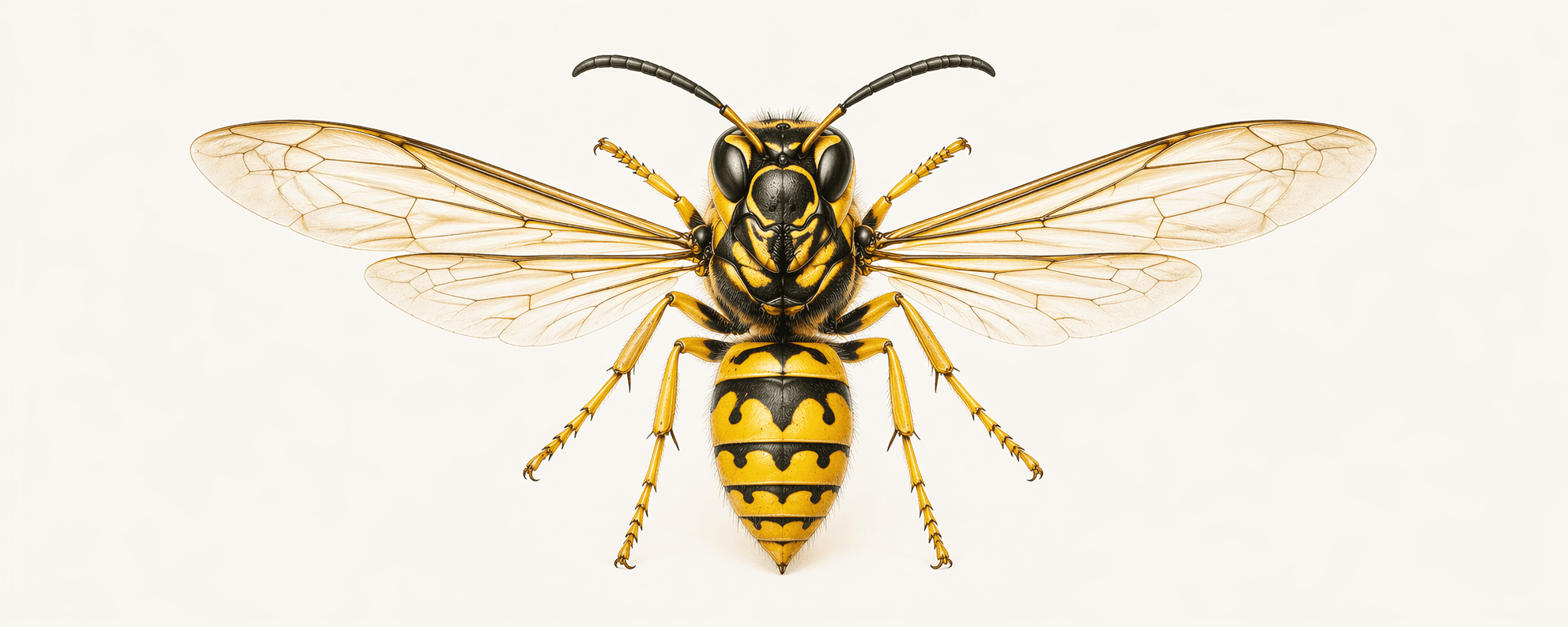
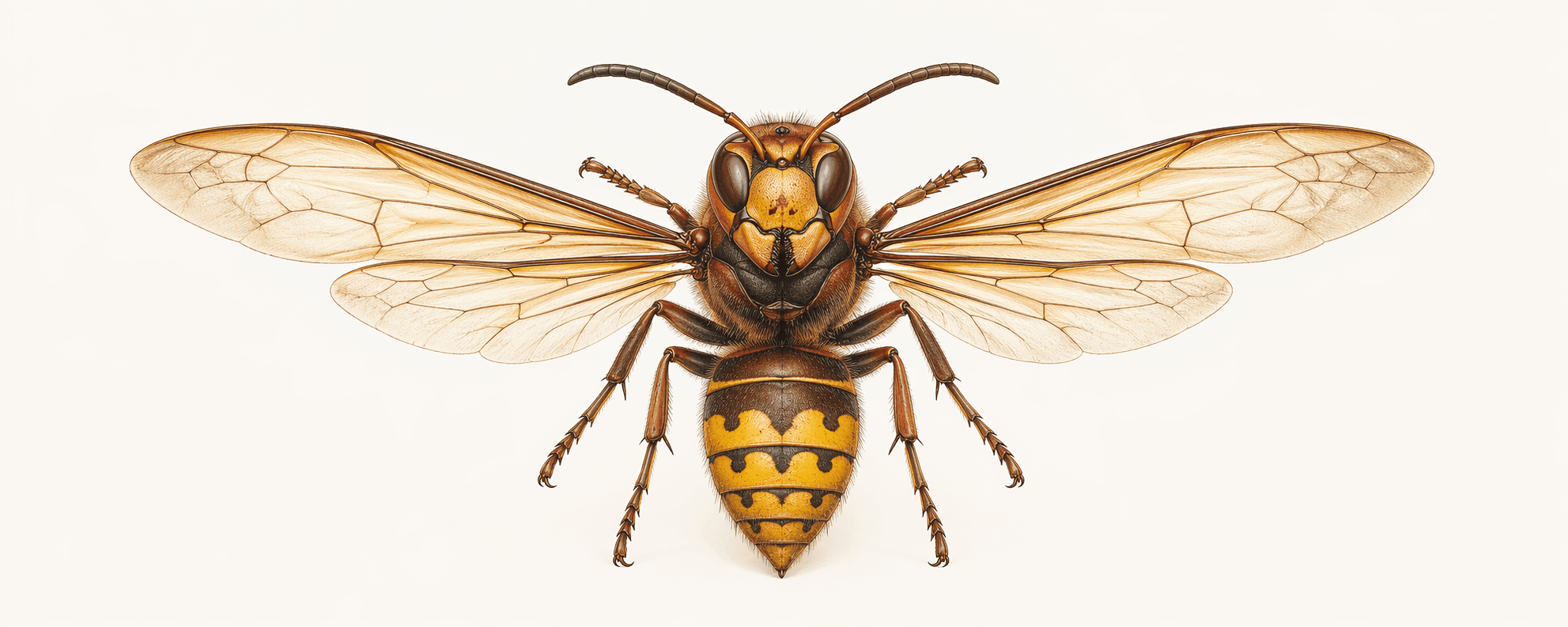
The Asian hornet is recognised by its very dark dominant tone. Seen from afar, it appears almost entirely black. Its abdomen bears only a single broad orange band towards the rear, the rest being dark brown to black. A decisive and very practical detail: the tips of its legs are clearly yellow, as if it were wearing pale "socks". This dark-leg / yellow-tip contrast shows well in flight and is an almost unmistakable signature.
The European hornet, on the contrary, displays warm, contrasting colours: a brown-red thorax and abdomen base, then yellow segments striped with black. Its head is reddish, its face yellow. The whole resembles a classic wasp, but much larger. Where the Asian hornet looks plain and dark, the European looks colourful and "striped". This dark-versus-red-yellow opposition settles the vast majority of photo identifications. For cases of confusion with ordinary wasps, our dedicated page on wasps and hornets clarifies the other useful nuances.
A word of caution, however, on viewing conditions: light changes the perception of colour. In full sun, the dark abdomen of the Asian hornet can take on brown reflections that deceive the eye; against the light, the warm colours of the European fade and make it darker than it is. It is precisely for this reason that a single criterion is never enough: colour is always cross-checked with silhouette, behaviour and, when possible, the appearance of the nest. A photo taken in neutral light, neither dazzling nor backlit, remains the best support for reliable confirmation.
Behaviour: diurnal predator versus twilight pacifist
Behaviour is probably the most revealing criterion for an attentive observer, because it requires neither capture nor a close-up.
The Asian hornet is a formidably specialised diurnal predator. Its activity stops at nightfall. Its most characteristic behavioural signature is hovering flight: it can literally be seen holding position in front of a hive or a food source, like a helicopter, watching for honeybees that it captures in mid-air to feed its colony. This "fishing" of bees in front of hives is an unmistakable sign, and it explains the concern of Riviera beekeepers.
The European hornet follows a very different rhythm. A discreet hunter of insects, it is active by day but also at dusk and even at night — it is one of the rare hornets attracted to light, which explains why it is sometimes found bumping against lit windows in the evening. Away from its nest, it is remarkably peaceful: it does not seek contact and only stings under direct threat. It does not hover in front of hives and does not exert the same pressure on honeybee colonies. If you see a large insect drawn to your terrace lamp on a summer evening, it is very likely a European hornet, not an Asian one.
The nest: shape, height and location
The location and shape of the nest form another very reliable set of clues, often easier to observe than the insect itself.
The Asian hornet builds a characteristic nest of chewed paper, shaped like a sphere or a large pear, with a side entrance. At peak season, this secondary nest can reach the size of a large ball, or more. It is frequently located very high, at the crown of tall trees, sometimes fifteen or twenty metres above the ground, which makes it invisible while the foliage is dense — it is often discovered only in autumn, when the leaves fall. It can also settle under a roof overhang, in a thick hedge or on an open frame. This height clearly complicates intervention and requires suitable equipment.
The European hornet, for its part, often prefers cavities: a hollow trunk, a hole in a wall, a rolling-shutter box, a corner of an attic or a shed. Its nest, also of chewed paper, is more rarely out in the open at a treetop. This preference for sheltered spaces is a further clue: a clearly visible spherical nest high in a tree points strongly to the Asian hornet, while a colony tucked in a cavity points to the European. For everything concerning colonies perched high and the difficulties they raise, our protocols are detailed on the Asian hornets page.
Life cycle and status: native versus invasive
Understanding the annual cycle helps interpret what one observes by season. In both species, only young fertilised queens overwinter, sheltered. In spring, each founding queen builds a small primary nest alone and lays the first workers. The colony grows all summer, peaks in late summer and early autumn, then produces new queens and males before declining. In the cold season the nest dies and is never reused the following year.
The fundamental difference lies in the status of the two species. The European hornet is native: it has always been part of the local ecosystem and holds a useful place there by regulating other insects. The Asian hornet is an introduced species, which arrived in Europe in the early 2000s and whose spread has been rapid and continuous. Along the Mediterranean coast and the Riviera, its presence was confirmed gradually through the 2010s. Its invasive character and its predation on honeybees make it a major concern for local biodiversity and beekeeping, whereas the European hornet does not pose this kind of problem.
Why the European hornet often deserves to be spared
This is a point we consistently stress: killing a European hornet is almost never justified. A native species, generally little aggressive away from its nest, it does a service by hunting flies, caterpillars and other insects. A nest set up high, in a hollow trunk away from traffic areas, usually poses no danger and can simply be left in peace until its natural death in autumn.
The reasoning differs for the Asian hornet, whose pressure on honeybee colonies and tendency to build large nests near dwellings justify active management. But even then, intervention must remain targeted, reasoned and proportionate — never a reflex of blanket destruction that would strike all species indiscriminately. It is precisely because the two hornets call for opposite responses that prior identification is no detail: it is the heart of responsible management. Wrongly wiping out a colony of peaceful Europeans deprives the garden of a useful ally for nothing.
Identifying from a photo, before any intervention
In practice, the good news is that reliable identification almost never requires approaching a nest or capturing an insect. A sharp photo is enough in the vast majority of cases. We therefore systematically request images before drawing up a quote, which allows a remote assessment, without risk and without an unnecessary visit.
For a usable photo, a few simple reflexes suffice: frame the insect from the side to see the abdomen and legs, try to capture the orange band and the leg tips, and if you photograph a nest, note its height, shape and location. In case of doubt, film a few seconds of flight: behaviour — hovering or not, night activity or not — often lifts the ambiguity. These elements, sent through our free quote request, let us confirm the species, assess the level of risk and propose, only if necessary, a suitable intervention. Our Certibiocide N°121134 accreditation governs all of these technical operations. And if the situation already seems critical to you, our guide on what to do in an emergency with wasps and hornets sums up the right immediate reflexes.
Field experience on the Riviera: what observation has taught us
Field observation, accumulated since the early 2010s along the coast, confirms a few useful regularities. First, confusion is massive: the vast majority of "Asian hornet" reports we receive actually concern either a European hornet or simply a large wasp. Fear amplifies perception, and the word "Asian" acts as an anxiety trigger.
Next, seasonality is very marked. The first founding queens are seen in spring, colonies become visible and active in summer, and it is in late summer and autumn that the large nests reveal themselves, often as the trees lose their leaves. Many late discoveries correspond to nests that had been there for months, simply masked by foliage.
Finally, location matters as much as species. A European hornet nest in an isolated trunk at the far end of a garden does not carry the same weight as an Asian hornet nest under the eaves of a busy terrace. It is the combination of species + location + human traffic that determines the true priority. Hence our unvarying method: identify first, measure the risk next, and intervene only when it is genuinely justified. This rigour spares useful colonies, concentrates resources where they count, and avoids many pointless acts. At the slightest doubt, a photo and a few questions are worth more than a hasty decision.
One final lesson is worth sharing: anticipation is always better than emergency. A nest spotted early, in spring or early summer, while still small and low, is infinitely simpler to manage than a large colony discovered in autumn at the top of a tree. We therefore encourage everyone to keep a regular eye on their garden, hedges and roof overhangs from the first fine days, and to photograph any insect or any nest beginning that raises a question. This simple reflex, free of cost and risk, often turns a heavy intervention into a reassuring observation — and that is just as it should be.
Zones served in Monaco and on the Riviera
Frequently asked questions
- How can I tell an Asian hornet from a European hornet at a glance?
- Overall colour is the most reliable clue. The Asian hornet looks very dark, almost black, with a single orange band on the abdomen and bright yellow leg tips. The European hornet is larger, brown-red and yellow striped with black, resembling a giant wasp. Dark versus red-yellow: that contrast settles most cases.
- Is the Asian hornet bigger than the European hornet?
- No, it is the opposite. The European hornet is the larger of the two, up to about 35 mm, while the Asian hornet is usually 17 to 32 mm. Its reputation makes it seem impressive, but in pure size the European wins. Size, however, remains a clue to be confirmed by colour and behaviour.
- Should a European hornet nest be destroyed?
- Usually not. The European hornet is a native species, not very aggressive away from its nest and useful because it regulates other insects. A nest located high up or away from busy areas can be left alone until it dies naturally in autumn. Intervention is only considered if it sits very close to a frequently used living space.
- Why is the Asian hornet considered a threat?
- Because it is invasive and preys on honeybees. Hovering in front of hives, it captures foragers to feed its colony, which weakens apiaries and worries beekeepers. Introduced to Europe in the early 2000s, it spread along the Mediterranean coast through the 2010s. The European hornet, being native, does not cause this problem.
- Can the hornet be identified from a simple photo?
- Yes, and it is in fact the method we prefer before any quote. A clear side photo showing the abdomen and legs is enough in the vast majority of cases. For a nest, note its height, shape and location. When in doubt, a short video of the flight helps decide. This remote assessment avoids any unnecessary travel or risk.
- When do hornet nests become visible on the Riviera?
- Founding queens appear in spring, colonies grow through summer, and large nests mostly reveal themselves in late summer and autumn, often when trees shed their leaves. Many nests found late had been there for months, hidden by foliage. That is why careful observation from spring onward makes early, proportionate management easier.