July 13, 2026 · 12-minute read
Hornet Nest at Height in Monaco: 20-Metre Pole Removal
Hornet nest at height in Monaco? Our 20-metre telescopic pole neutralises nests in trees, cornices and roofs — no scaffolding, no cherry picker needed.
A hornet nest at height in Monaco — hanging 15 or 20 metres above a garden, anchored to a Belle Époque cornice or hidden in the crown of a pine tree — is one of the most common and most dangerous situations we handle between spring and autumn. Unlike a wasp nest tucked into a low wall, a hornet nest at height cannot be treated with a supermarket aerosol or from a stepladder. It requires specialist equipment, a full protective suit and a proven method. At Monaco Pest Solutions, we neutralise hornet nests with a telescopic pole reaching up to 20 metres in height, without scaffolding or a cherry picker in the vast majority of cases. Here is everything you need to know before acting.
Why do hornets build their nests at height?
Height gives a hornet colony three decisive advantages: protection from ground predators, favourable sun exposure, and a clear flight corridor for the hundreds of workers coming and going every day. In Monaco, the most frequent elevated nesting sites are:
- Ornamental trees: umbrella pines, palms, magnolias, cypresses and old olive trees in villa gardens. The nest often stays invisible from the ground while foliage is dense, and can reach the size of a beach ball by late summer.
- Belle Époque cornices and mouldings: the Principality's ornate façades offer countless rain-sheltered recesses, perfect for anchoring a nest 10 to 20 metres above the street.
- Roof overhangs and under-roof voids: the space between eaves and roof structure stays dry, dark and temperate — an ideal habitat.
- Rooftop plant rooms, chimneys and lift housings on Monaco's apartment buildings.
The later the season, the larger the nest and the more defensive the colony. A nest spotted at height in July already holds several hundred hornets; by September it may shelter thousands.
Primary nest in spring, secondary nest in summer
Understanding the hornet life cycle is essential to judging how urgent an intervention is.
The primary nest (April-May) is built by the founding queen alone after hibernation. It is the size of an orange, has a single downward-facing opening, and usually sits at low or medium height: garden sheds, balconies, roller-shutter boxes, roof edges. This is the ideal moment to act — the colony numbers fewer than ten individuals, and destroying the nest eliminates the queen and therefore the entire future colony.
The secondary nest (June to November) appears when the growing colony relocates — almost always upwards. This is the large spherical or pear-shaped nest discovered at the top of a tree or under a cornice, sometimes only when the leaves fall in autumn. An Asian hornet secondary nest can measure 60 to 80 cm across and house 1,000 to 2,000 individuals. At this stage, any unprotected approach is extremely dangerous. Note that an abandoned primary nest in June does not mean the danger has passed: the colony has simply moved — usually higher and nearby. If in doubt, our team can identify a nest from a photo via our free quote form.
Asian hornet or European hornet: identify before acting
Both species live along the Mediterranean coast, but their behaviour — and the risk level — differ.
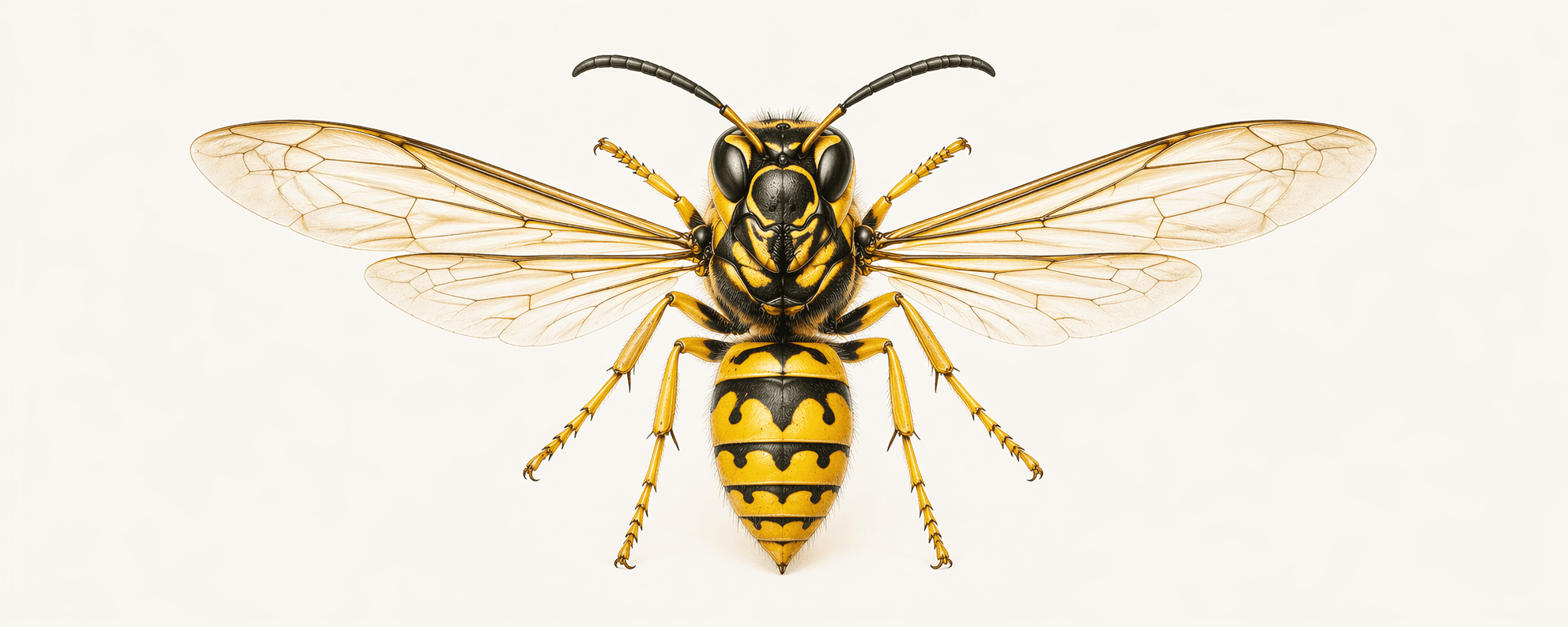
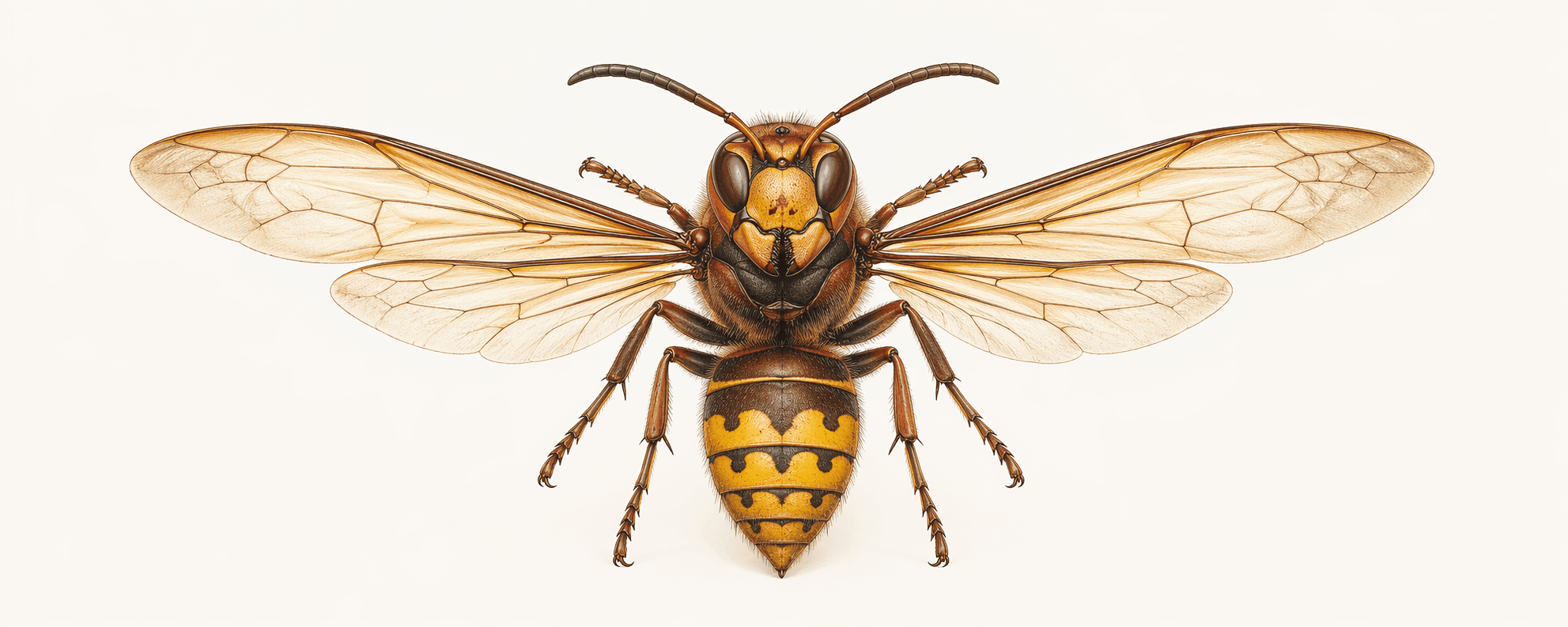
The Asian hornet (yellow-legged hornet) has a black thorax, a dark abdomen with a broad orange band and yellow leg tips. It readily builds its secondary nest very high in trees, up to 20 metres and sometimes more. It is a fierce predator of honeybees and an aggressive defender of its nest, attacking in groups as soon as it detects vibration or a silhouette within 5 to 8 metres. Its spread along the Riviera makes it the main cause of the elevated nests we treat in Monaco. Learn more on our dedicated Asian hornets page.
The European hornet is larger (queens up to 3.5 cm), with a yellow abdomen striped with black and a reddish head. Less aggressive, it prefers cavities: hollow trunks, attics, chimneys, under-roof spaces. Its sting remains painful and dangerous for allergic people, but mass attacks are rarer.
Correct identification determines the strategy: product, safety distance, timing. If in doubt, do not approach — send us a zoomed photo taken from a distance.
Why Monaco is particularly exposed
The Principality combines several factors that favour hornet nests at height:
- A mild year-round climate: gentle winters increase the survival rate of founding queens, which restart their cycle as early as March. The hornet season lasts longer here than elsewhere.
- Terraced, vertical urbanisation: Monaco is built on a hillside overlooking the sea. A nest at roof level of one building can sit at terrace level of the building next door, directly exposing residents. Verticality multiplies contact points between elevated nests and living spaces.
- Villa gardens and planted terraces full of mature trees, water features and flowers — a permanent food supply for colonies.
- An ornate Belle Époque heritage: cornices, balustrades and carved overhangs offer sheltered nesting sites that are often unreachable without specialist equipment.
- Wooded hills immediately behind the city, from which colonies naturally spread into the Principality's gardens and façades.
Urban density adds a further constraint: a nest at height rarely overlooks a single property. Pavements, restaurant terraces, pools, schools or building sites may all lie within the colony's defence zone, which makes a fast, discreet and fully controlled intervention essential.
Why DIY removal at height is dangerous
Destroying a hornet nest yourself is inadvisable at ground level. At height, it is a risk we must strongly discourage:
- Falls. Climbing a ladder, roof or tree in protective clothing — vision restricted by the hood, movements hindered by gloves — invites a serious fall. The slightest attack triggers a reflex recoil, disastrous at 10 or 15 metres above the ground.
- Swarm attacks. A disturbed secondary nest releases dozens of defenders within seconds. Asian hornets pursue their target over long distances and can spray venom towards the eyes. Multiple stings cause severe envenomation even in non-allergic people.
- Anaphylactic shock. A single sting can be enough for a sensitised person. At height, alone, with no quick escape, the consequences can be fatal. Every summer, our 24/7 emergency line receives calls following DIY attempts that went wrong.
- Ineffectiveness. Retail aerosols reach 4 or 5 metres at best. Used on a nest at height, they irritate the colony without eliminating it: the hornets become more aggressive for days, and the partially treated nest recovers. A badly treated nest is more dangerous than an untouched one.
There is also the question of liability: if an improvised attempt provokes an attack on passers-by, neighbours or workers, you may be held responsible. The right reflex: secure the perimeter, keep children and pets away, close nearby windows and call a professional. Practical waiting steps are detailed in our guide on what to do in a wasp emergency in Monaco.
Our technique: telescopic pole up to 20 metres
This is the core of our know-how for hornet nests at height in Monaco: destruction by telescopic pole up to 20 metres, carried out from the ground or from a secured vantage point.
Our technician — Certibiocide certified N°121134, operating under RCI Monaco 26S10394 — deploys a lightweight insulated fibre pole fitted with an injection or dusting head. A professional delayed-action insecticidal powder is delivered directly into the nest entrance. Returning workers pick up the product and spread it to the heart of the colony, reaching the queen and the brood. The colony dies off within 24 to 48 hours.
The advantages are decisive:
- Maximum safety: the operator stays outside the colony's defence zone, in a full protective suit (thick coverall, meshed hood, reinforced gloves).
- No scaffolding, no cherry picker in most cases: no road-occupation permits, no bulky truck in Monaco's narrow streets, no lifting equipment to mobilise.
- Speed: a typical intervention takes 30 to 60 minutes on site.
- Respect for buildings and trees: no branch cutting, no drilling into Belle Époque façades.
- Total efficacy: treating the core of the nest eliminates the queen, unlike surface spraying.
Above 20 metres or in exceptional layouts, we assess complementary solutions — rooftop access with fall-arrest equipment, or lifting platforms as a last resort. But in more than nine cases out of ten in Monaco, the 20-metre pole is enough.
How a typical intervention unfolds
- Remote diagnosis from photos or on site: species, nest type (primary or secondary), exact height, access constraints — free via our online quote request.
- Timing: early morning or dusk, when most workers are inside the nest.
- Perimeter securing: marking the area, closing windows, moving people back to a distance appropriate to the nest height.
- Equipment: full protective suit, telescopic pole extended to the required height, up to 20 metres.
- Biocide injection directly into the nest, in one or more passes.
- Verification and follow-up: activity check, intervention report, advice on possible nest removal. If activity abnormally persists after 72 hours — a rare event — we return at no extra charge.
A free, personalised quote for every intervention
We do not publish a price list, and for good reason: every intervention at height is priced in the quote according to the configuration — the exact height of the nest, its accessibility, the equipment required (pole, harness, lifting platform if necessary), the species involved and the colony's stage of development. Two nests at the same height can call for very different means depending on whether they overlook an open garden or an enclosed courtyard, a street façade or a private terrace.
What we do guarantee is transparency: a free quote, prepared quickly — often from a single zoomed photo —, a clear and final figure before any intervention, with no surprises discovered on site. A spring primary nest with easy access is naturally assessed differently from a late-summer secondary nest perched at 20 metres — one more reason to act early in the season. Physical removal of the neutralised nest, where desired and feasible, is specified in the same quote. Finally, beware of operators who announce a firm price without having seen the nest or assessed its height: serious work at height requires professional equipment, proper insurance and valid biocide certification.
After the intervention: removal, prevention, monitoring
Should the nest be removed? Not always. A hornet nest is never reused the following year, and a treetop nest breaks down naturally over winter. Under a cornice or in a roof void, however, removal is recommended: debris attracts other pests and an abandoned nest can mask new activity nearby.
How to avoid recurrence? Inspect attics, cornices and trees from April onwards to catch primary nests early; seal access points to roof voids; install selective queen traps in spring in previously affected gardens; thin out very dense trees. We offer seasonal monitoring contracts for Monaco's co-owned buildings and villas, with a preventive spring visit — the time of year when a nest takes ten minutes to neutralise rather than a full operation at 20 metres.
Hornets or wasps: don't confuse the emergencies
Many calls about "hornets at height" actually concern wasps — paper wasps under roof tiles, German wasps in a blind housing. The technical response differs: nest size, defensive behaviour, products and safety distances. Our wasps page helps you tell them apart in seconds, and our practical guide on wasp problems in Monaco explains what to do while waiting for help.
Spotted a hornet nest at height in Monaco? Keep at least 8 to 10 metres away and photograph it with a zoom — the photo lets us identify the species, notably the Asian hornet — then contact us. For immediate-risk situations — a nest above an entrance, a busy terrace or with an allergic person in the household — our 24/7 emergency service responds fast, weekends and public holidays included. With our telescopic pole technique up to 20 metres and full protective equipment, Monaco Pest Solutions neutralises hornets at height anywhere in Monaco — trees, Belle Époque cornices, roof voids — quickly, discreetly and without access works. Certibiocide N°121134 · RCI Monaco 26S10394.
Zones served in Monaco and on the Riviera
We operate in particular on Roquebrune-Cap-Martin and Menton.
Frequently asked questions
- Up to what height can you destroy a hornet nest without a cherry picker?
- Our telescopic pole lets us work up to 20 metres high, from the ground or a secured vantage point, without scaffolding or a cherry picker. This covers the vast majority of hornet nests at height in Monaco: treetops, cornices, roof voids. Beyond that, we assess secured roof access or, as a last resort, lifting equipment.
- What is the difference between a primary and a secondary nest?
- The primary nest, built by the queen alone in April-May, is orange-sized and usually sits low: it can be neutralised quickly and simply. The secondary nest appears in summer when the colony relocates — almost always upwards: it can reach 80 cm across and house thousands of hornets. The earlier the intervention, the simpler and safer it is.
- Can I destroy a hornet nest at height myself?
- No, we strongly advise against it. The combined risks of falling and swarm attack make the operation dangerous, and retail aerosols — effective over a few metres at most — make the colony more aggressive without eliminating it. Secure the perimeter, keep children and pets away, and call a certified professional equipped with a full protective suit.
- How much does destroying a hornet nest at height in Monaco cost?
- We do not publish a price list: every intervention at height is priced in the quote according to the configuration — nest height, accessibility, equipment required (pole, harness, lifting platform if needed) and the colony's stage. The quote is free, often prepared from a single photo, and the figure is clear and final before any intervention.
- Do you respond to emergencies, in the evening or at weekends?
- Yes. For immediate-risk situations — a nest above an entrance, a busy terrace, a schoolyard, or with an allergic person in the household — our emergency service is reachable 24/7, weekends and public holidays included, anywhere in Monaco. We prioritise these interventions and secure the perimeter as soon as we arrive.
- How do I tell an Asian hornet from a European hornet?
- The Asian hornet has a black thorax, a dark abdomen with a broad orange band and yellow leg tips; it readily nests very high in trees, up to 20 metres. The European hornet, larger, has a yellow abdomen striped with black and prefers cavities: hollow trunks, attics, chimneys. If in doubt, send us a zoomed photo taken from a distance.