July 26, 2026 · 12-minute read
Mosquito-free Monaco terrace: chemical-free trap for your receptions
Protecting a Monaco terrace from mosquitoes during a reception, without spraying the garden: a high-performing, 100% chemical-free next-generation trap, deployment 48h ahead, upwind positioning, CO2 attractant and larval-site removal.
Mosquito control on a Monaco terrace: the challenge of a summer reception
Hosting guests on a terrace in Monaco at the height of summer means offering them the very best of the Riviera: the softness of a Mediterranean evening, the sea view, the scent of jasmine and oleander, a table set beneath the olive trees. It also means, quite unintentionally, bringing together every condition that attracts mosquitoes at the exact moment you want them gone. Dusk, the residual humidity of watered flowerbeds, the warmth of a gathered crowd and the carbon dioxide everyone exhales form an irresistible cocktail for blood-seeking females.
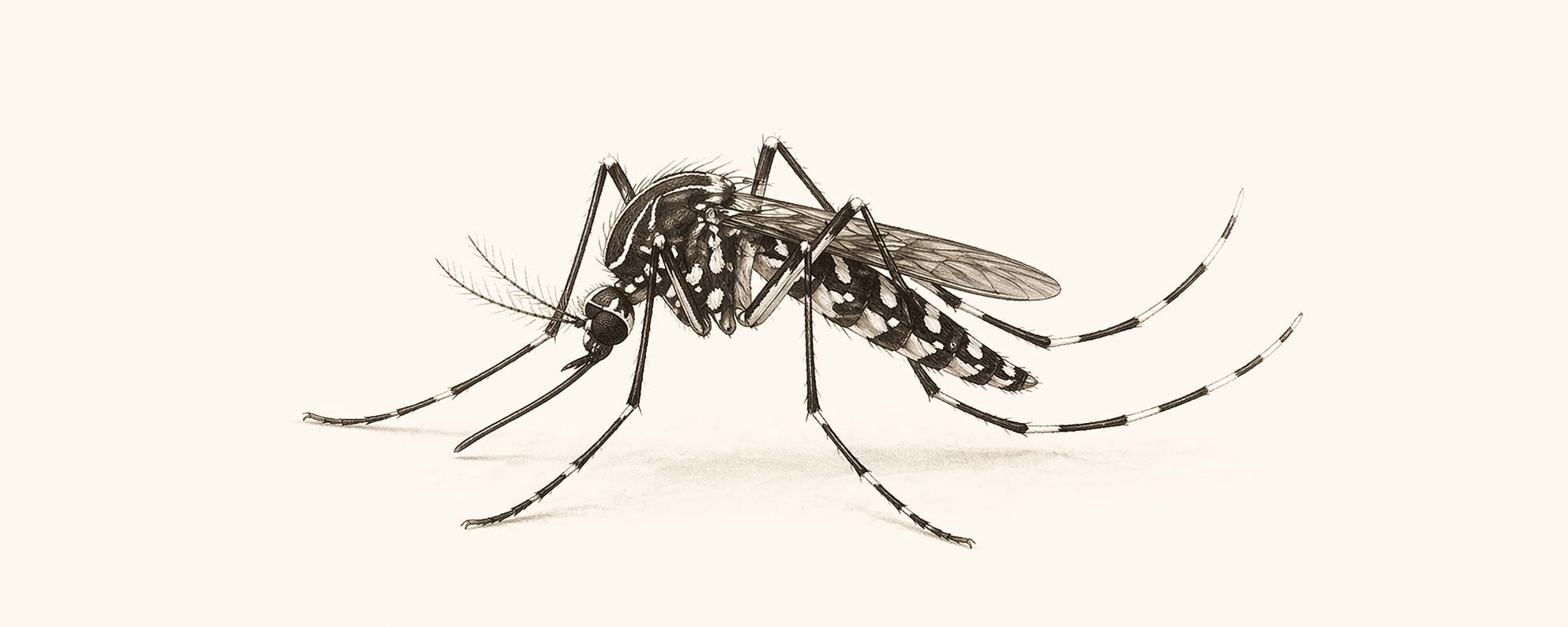
All along the coast, from Cap-d'Ail to Menton, mosquito protection on a Monaco terrace has become a central concern whenever an outdoor reception is planned. The tiger mosquito in particular has changed everything: active by day and in the early evening, aggressive, able to develop in the smallest saucer of water, it turns an idyllic evening into an ordeal for guests. Personal repellents, scented candles and last-minute misting are not enough to cover an entire terrace hosting dozens of guests.
The good news is that an outdoor reception without mosquitoes is entirely possible, and this without spraying the garden or exposing anyone to any substance. The method rests on a proven combination: a high-performing, entirely chemical-free next-generation trap, an anticipated deployment, strategic wind-aware positioning, and the upstream removal of larval breeding sites. This is the approach we detail here, drawn from our experience of high-end evenings, weddings and receptions on the Riviera.
The next-generation trap: high-performing and 100% chemical-free
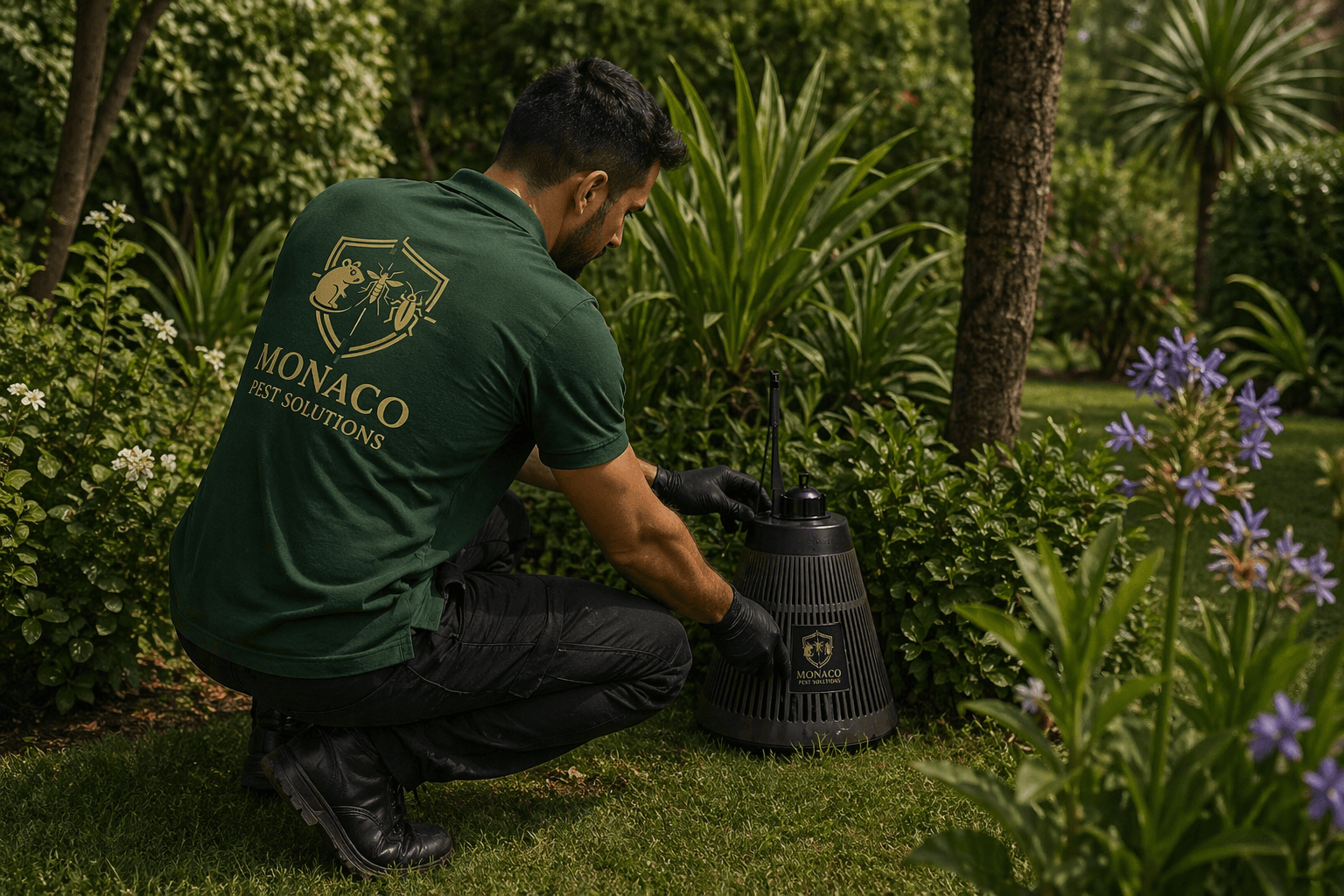
The heart of our system is a next-generation mosquito trap, designed to deliver a high level of performance without resorting to any chemical substance whatsoever. This is a decisive argument for a reception: where an insecticide spray imposes safety delays, odours and guest exposure, attractant trapping works silently, without residue, without danger to children, pets or gardens.
The principle is as elegant as it is effective. The trap does not repel mosquitoes: it attracts and captures them. By mimicking the signature of a human being — heat, humidity, carbon dioxide and body-odour lures — it diverts females from their real targets, the guests, and traps them for good. Each captured female represents around a hundred eggs that will never be laid, and therefore pressure that falls night after night across the whole property.
This total absence of chemicals is our core value: it makes the solution safe in the most sensitive contexts. These devices can be installed near a set table, a children's area, a vegetable patch or an ornamental pond without any special precaution. Cut flowers, tablecloths, crockery and buffet dishes are never in contact with anything. This is exactly what hosts are looking for when they want to offer a flawless evening, where effectiveness against pests costs nothing in comfort or peace of mind.
This biocide-free trapping is part of a logic we develop more fully in our guide to chemical-free mosquito traps: durable protection that also safeguards the garden's biodiversity, bees and pollinators included.
How the CO2 attractant mimics human presence
To understand why this kind of trap works, you have to look at it from the mosquito's point of view. A female seeking a blood meal does not see her victims: she detects them from a distance thanks to a set of signals. The first and most powerful is carbon dioxide, the gas every living being exhales while breathing. A plume of CO2 forms a trail the mosquito follows over dozens of metres, before refining its approach at close range using heat, humidity and the odour compounds of the skin.
The next-generation trap faithfully reproduces this signature. It releases a flow of carbon dioxide that simulates the breathing of a group of guests, combined with a heat source and lures imitating body odour. To the female, the lure becomes more attractive than the guests themselves: she approaches, is drawn in or captured, and will not leave. It is this diversion of the human signal that explains the real effectiveness of a well-tuned trap.
The CO2 attractant offers an additional advantage during a reception. Concentrated around the trap, placed slightly back from the living area, it creates a point of appeal that draws mosquitoes away from the table and the guests. The aim is not to build a watertight barrier, an illusion outdoors, but to shift the pressure: females are drawn to the periphery, where they are captured, rather than to the centre of the party. Correctly dosed and well positioned, this system discreetly transforms a garden's dynamics for the duration of an evening, and well beyond if left in place.
Deployment 48 hours before the event: the decisive window
The most common mistake is to install a mosquito device on the very day of the reception, a few hours before guests arrive. It is too late. An attractant trap does not produce its full effect instantly: it needs time to begin reducing the local population of females present around the property. This is why we systematically recommend deployment at least 48 hours before the event.
This two-day window is not arbitrary. It corresponds to the time needed for the trap to capture a first significant wave of adult mosquitoes active in the area, and for the attractant plume to establish itself and durably guide flight paths. In 48 hours, a well-positioned device has already removed from the garden a notable share of the females that, without it, would have invited themselves to the party. On the evening itself, pressure has dropped, and the trap keeps capturing in real time the individuals venturing in from neighbouring properties.
This early deployment also allows the device to be checked and adjusted calmly, without the pressure of the event. Our technicians verify that the attractant sources are working properly, measure the real activity from the first captures, and reposition the traps if needed based on what the ground reveals. No terrace is ever identical to another: wind exposure, the presence of a pool, the proximity of a dense hedge or a water point change everything. The 48-hour lead time offers the margin needed to turn a theoretical installation into a device calibrated to the reality of the place.
For receptions decided at short notice, or when an infestation reveals itself at the last minute, an accelerated intervention remains possible through our 24/7 emergency service, even though nothing replaces anticipation.
Strategic positioning: playing the wind and ringing the zone
A high-performing trap poorly placed loses much of its value. Positioning is probably the factor that distinguishes an amateur installation from a professional device. The guiding principle comes down to one word: wind. The CO2 attractant spreads as a plume, and this plume is carried by the prevailing breezes. Placing the traps upwind of the reception area allows the attractive odour to sweep across the garden and intercept mosquitoes before they reach the guests.
In practice, this means identifying the usual direction of the late-day breeze over the terrace — often a sea breeze or a downdraught from the heights — then arranging the traps so that their signal is pushed towards the guests, while the mosquitoes, following that signal upstream, run into the devices. In this way a line of interception is created between the likely mosquito sources (hedges, undergrowth, neighbouring properties, water points) and the living space.
The second principle is that of the ring. Rather than a single central trap, we prefer a ring of devices positioned around the perimeter of the area to be protected, away from the tables. This layout physically distances the points of attraction from the guests: mosquitoes are called outward, not towards the buffet. The distance, orientation and number of traps are determined according to the surface area, the shape of the terrace and the vegetation layout.
This positioning work requires a fine reading of the ground that only a prior visit allows. It is one of the major contributions of an on-site assessment, which we offer as part of a free quote tailored to the exact configuration of the property.
Coordination with the caterer and the evening's organisation
A successful reception rests on precise choreography between many contributors, and the mosquito device must fit in without ever hindering the service. Coordination with the catering team in charge of the meal is essential here. The buffet, outdoor cooking areas, sweet desserts and drinks generate their own insect calls; service routes, the paths used by staff and technical spaces must stay clear.
We therefore take the time, upstream, to talk with those in charge of the organisation to set the placement of the traps according to the evening's plan. Where will the tables be set? Where will the bar be? Which way will the dishes travel? Where will guests dance or have their aperitif? Each of these answers influences positioning. A trap must never sit on a passage route, nor too close to a food source that would compete with its attractant, nor in the immediate line of sight of the guests.
This coordination also concerns the schedule. Deployment 48 hours before the event must be articulated with the installation of furniture, any marquee, lighting and sound. We ideally intervene before the heavy equipment is set up, then return for a final check and adjustment once the decor is in place. The aim is that, when evening comes, the device is entirely invisible and silent, blended into the landscape, while working continuously.
This discretion is an absolute requirement on the Riviera, where the refinement of a reception is also measured by what is not seen. The best mosquito device is the one whose existence no guest suspects, but which everyone benefits from without knowing: an evening where mosquitoes are never mentioned, quite simply because there are none.
Outdoor evening protection against the tiger mosquito: complementarity with the larval-site audit
Trapping captures adult mosquitoes, but it would not be complete without tackling the source: the larval breeding sites. Genuine outdoor evening protection against the tiger mosquito always combines these two aspects. Removing the adults present treats the symptom; eliminating the egg-laying sites cuts off production. The two approaches are inseparable and reinforce each other.
The tiger mosquito is an opportunistic breeder, able to develop in tiny volumes of water: a saucer under a pot, a fold in a tarpaulin, a clogged gutter, a vase, a forgotten toy, a hollow parasol base, a drainage inspection chamber. A reception garden, with its floral arrangements, its watering and its ornamental water points, multiplies these micro-sites without anyone noticing. A methodical audit consists of going over the entire property to identify, empty, clear out or treat each of these receptacles.
Carried out ahead of an event, this audit produces a double benefit. In the short term, it reduces the number of mosquitoes that will emerge in the days following the inspection, reinforcing the trapping effect for the evening. In the long term, it durably cleanses the garden by breaking the reproduction cycles. It is the combination of breeding-site removal and attractant trapping that delivers the clearest and most stable results, far better than a one-off spraying whose effect evaporates within a few days.
To understand in depth the biology and behaviour of this species, and the reasons why prevention is more effective than last-minute control, we refer to our complete file on the tiger mosquito. It is by knowing the adversary that one designs the most fitting protection.
A mosquito trap for a reception or dinner: field feedback from the Riviera
The experience accumulated on Riviera receptions now makes it possible to offer a proven set-up for each type of event. A mosquito trap for a reception or dinner is not deployed the same way for a large marquee wedding, an intimate terrace dinner or a standing cocktail in a sloping garden. Each configuration has its constraints, and each has found its answer.
At outdoor weddings, where dozens or even a hundred guests gather from dusk until late into the night, the ring strategy comes into its own. The device is deployed well in advance, adjusted after surveying the seating plan and dance areas, and it runs continuously throughout the festivities. The hosts' feedback is almost always the same: no one noticed any mosquitoes, and no one noticed the traps. That is precisely the result sought.
For more intimate dinners, on a terrace or around a pool, the approach is more targeted: a few well-placed devices upwind are often enough to pacify the space, provided the breeding-site audit was done beforehand. We regularly observe that guests, used to cutting their summer evenings short because of bites, naturally linger without even identifying what has changed.
This field feedback constantly nourishes our method. It confirms a simple conviction: on the Riviera, the success of an outdoor reception rests on invisible preparation. A calibrated device, deployed in time, positioned according to the wind and backed by breeding-site removal, delivers an evening where the subject of mosquitoes simply no longer exists.
Our commitment: effectiveness, discretion and total safety
Our approach to receptions rests on three inseparable requirements: real effectiveness, absolute discretion and uncompromising safety. We systematically favour the solution with the least impact on the environment and on the occupants, which explains our choice of next-generation trapping without any chemical product. This rigour lets us intervene serenely in the most sensitive contexts, with families with young children, pets or gardens one wishes to preserve.
Every intervention begins with an assessment of the site. We never propose a standardised device: the surface area, the exposure, the vegetation, the presence of water points and the flow of the event dictate a bespoke configuration. Our technicians work within a declared and regulated activity, holders of the Certibiocide N°121134 approval, a guarantee of the seriousness and professionalism demanded by the properties and receptions we support across the Riviera.
This commitment extends into follow-up. A device can remain in place beyond the evening to keep protecting the garden throughout the season, extending the benefits well after the last guest has left. The logic is not that of a one-off intervention masking a problem, but of durable control that cleanses the site.
Whether you are preparing a large wedding, a professional reception or a simple terrace dinner, the best decision remains to anticipate. A prior visit makes it possible to size the device precisely and guarantee a serene evening. For each project we draw up a bespoke free quote, based on the real configuration of the site and the requirements of the event. On the Riviera, a beautiful summer evening is prepared out of sight — and out of reach of mosquitoes.
Frequently asked questions
- Is a chemical-free mosquito trap powerful enough for a reception?
- Yes. The next-generation trap we deploy is designed for a high level of performance without any chemical substance. It attracts females using a CO2 attractant, heat and body-odour lures, then captures them. For an evening, effectiveness rests above all on early deployment, upwind positioning and prior removal of larval sites. It is this combination, not a single product, that guarantees a peaceful terrace.
- Why install the device 48 hours before the event?
- Because an attractant trap works gradually. In 48 hours it captures a first wave of adult mosquitoes around the property and the attractant plume establishes itself to durably guide flight paths. On the evening of the reception, pressure has already dropped markedly, and the trap keeps capturing in real time the individuals coming from neighbouring properties. Installing the equipment on the day itself leaves no time for this mechanism to work.
- Does the trap pose any danger to children or animals?
- No. That is precisely the point of 100% chemical-free trapping: no residue, no sprayed substance, no special precaution. The devices can be placed near a children's area, a vegetable patch, a pond or pets without risk. Unlike an insecticide spray, there is neither a safety delay nor odour, which makes the solution ideal for a family reception or in the presence of sensitive guests.
- How does positioning relative to the wind affect effectiveness?
- The CO2 attractant spreads as a plume carried by the breeze. By placing the traps upwind of the reception area, the odour sweeps the garden and intercepts mosquitoes before they reach the guests. This is completed by a ring layout, a circle of devices around the perimeter, away from the tables, to draw mosquitoes outward. This fine tuning requires a reading of the ground during a prior visit.
- Is trapping enough, or must the larval sites also be treated?
- Trapping captures adult mosquitoes, but for a lasting result it must be paired with removal of the larval sites. The tiger mosquito lays in the smallest pool of stagnant water: a saucer, a gutter, a vase, a fold in a tarpaulin. A methodical audit of the property makes it possible to empty, clear out or treat these receptacles and cut off the production of new mosquitoes. It is the combination of the two, capturing adults and removing sites, that delivers the clearest and most stable results.
- Is the device discreet and compatible with the caterer's service?
- Yes, discretion is an absolute requirement of our method. We coordinate the placement of the traps with the catering team and the organisers, taking into account the table plan, the bar, service routes and dance areas. The devices are placed around the perimeter, never on a passage route nor in the guests' immediate line of sight. Once the decor is in place, they blend completely into the landscape: come evening, no one notices them, but everyone enjoys a mosquito-free terrace.