November 26, 2026 · 5-minute read
Silverfish in Monaco: why they come out in winter
Bathroom, cupboards, bookshelves: in winter, silverfish take advantage of condensation. How to recognise them, correct the moisture and know when to call a professional.
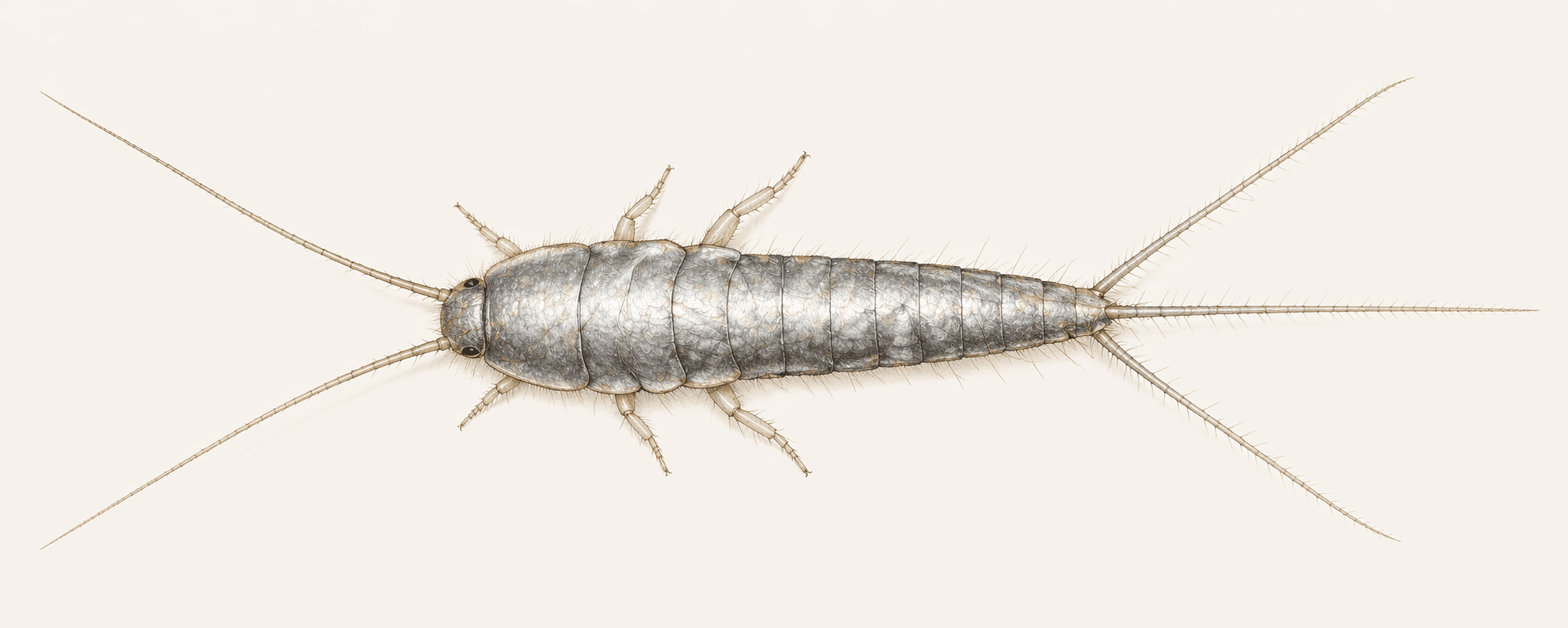
You switch on the bathroom light and a small silvery insect darts under the skirting board. It is almost always a silverfish. In Monaco, people notice them mostly in winter: windows stay closed, hot showers follow one another, laundry dries indoors, and the moisture that builds up in wet rooms gives the silverfish exactly what it needs. Here is how to recognise it, why it settles in and what to do about it.
Recognising a silverfish
The common silverfish (Lepisma saccharinum) is a small wingless insect with an elongated body that tapers towards the rear, covered in grey scales with a silvery sheen. It has two long antennae at the front and three filaments at the back. It moves quickly with a wriggling motion, hence its name. It is active at night and shuns light: you mostly see it when you suddenly switch on a light.
Two relatives can cause confusion:
- the firebrat (Thermobia domestica), more mottled, which seeks warmth rather than moisture: it is found near boilers, ovens or hot-water pipes;
- the grey long-tailed silverfish (Ctenolepisma longicaudata), larger and duller, reported more and more often in European homes, and able to live in drier rooms such as a living room or a bedroom.
Identifying the species correctly changes the response: excess heat is not dealt with the same way as excess moisture. Our page on silverfish details the signs to look for.
Why they show up more in winter
Silverfish need moisture to survive. In summer, homes are aired a lot and rooms dry quickly. In winter, it is the opposite: windows are opened less, and steam from showers and cooking condenses on cold walls, in tile joints, behind furniture pushed against outside walls and in under-sink cupboards. Heating warms the air, but not necessarily the corners where water settles.
In the Principality's buildings, often adjoining and connected by service ducts, cellars and water risers, silverfish also move from one home to another. A spotless flat can host them because the neighbouring cellar or duct is damp. It is the same mechanism as for the other insects that thrive on central heating in winter.
Are they dangerous?
Not directly to health: silverfish do not sting, do not bite and transmit no known disease to humans. Their scales and droppings can, however, add to household allergens for sensitive people, just like dust mites in winter.
The real risk is material. Silverfish feed on starch, cellulose and glues: paper, cardboard, book bindings, photos, wallpaper, starched natural textiles, crumbs of flour or cereal. In a library, archives, a wine cellar with old labels or a linen cupboard, an established population eventually leaves its mark: nibbled page edges, gnawed labels, small yellowish stains.
Above all, their presence is an indicator: where they thrive, humidity is too high, and mould or other small insects are never far away.
What you can do yourself
- Air the bathroom and kitchen every day for a few minutes after showering or cooking, and check that the ventilation or extractor fan works.
- Track down water: a leak under the sink, a cracked bath seal, a seeping trap, laundry drying in a closed room.
- Move furniture slightly away from outside walls to let air circulate.
- Store papers, books and photos in closed boxes, away from cellars and damp cupboards.
- Vacuum skirting boards, the backs of cupboards and joints, then throw the bag away.
- Avoid shop-bought aerosols: they drive the insects back into the walls without fixing the cause.
If you keep seeing them after a few weeks of airing and drying, or if you find them in several rooms, the population is probably established in the partitions, the ducts or the cellar.
When to call a professional
An intervention is justified when silverfish keep coming back despite your efforts, when valuable documents, books or textiles are at risk, or in premises open to the public: hotel, restaurant, shop, residence, offices with archives.
The technician starts by looking for the source of moisture and the routes the insects use, then combines mechanical measures (vacuuming, dry steam, sealing gaps) and, only if necessary, a targeted treatment in cracks and ducts. It is a reasoned insect control approach: as long as the humidity is not corrected, no product solves the problem for good.
Our technicians work in plain clothes, with an unmarked vehicle. Our switchboard answers from 8 am to 10 pm every day and we intervene 24/7, anywhere in Monaco, in French and English.
Need advice?
Free on-site audit, then a free, no-obligation quote. If you can, take a photo of the insect before calling us: it helps identify it.
Request your free quote or call +377 37 70 70 02: reply within 6 hours.
Frequently asked questions
- How much does silverfish treatment cost in Monaco?
- It depends on the size of the population, the source of moisture to correct, the surface area and the layout of the premises. We start with a free on-site audit, then draw up a free, no-obligation quote. Call +377 37 70 70 02: reply within 6 hours.
- Do silverfish bite or transmit diseases?
- No. Silverfish do not sting, do not bite and transmit no known disease to humans. They mainly damage paper, books, photos and starched textiles, and their presence signals excess moisture that needs correcting.
- Why do I have silverfish when my flat is clean?
- Because silverfish are attracted by moisture, not dirt. Condensation in the bathroom, a small leak, laundry drying indoors, or a damp cellar or service duct in the building are enough for them to settle, even in a spotless home.