
Identifying silverfish: the signs that never lie
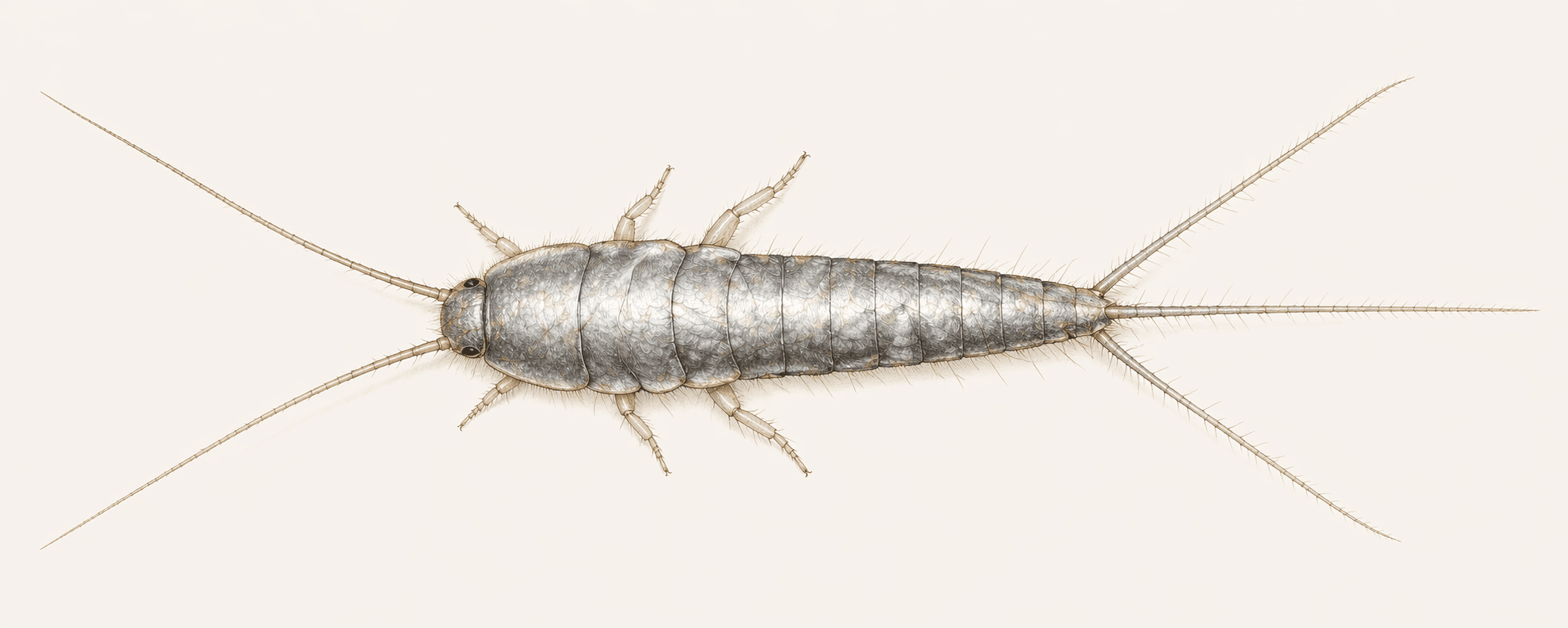
The silverfish (Lepisma saccharinum), commonly called the silverfish or fish moth, is a wingless insect measuring between 8 and 12 millimetres in adulthood. Its tapered body, covered with iridescent silvery scales, ends in three long caudal cerci. Two threadlike antennae extend from its head. Its undulating gait, quick and sinuous, evokes the movement of a fish in water — hence its name.
Nocturnal and light-shy, the silverfish hides during the day in dark, damp crevices. Here are the clues that betray its presence:
- Droppings: small granular black dots, similar to ground pepper, at the bottom of drawers, under skirting boards or behind furniture.
- Silvery scales: they come away easily when the insect is handled and glint under a torch.
- Characteristic damage: irregular notches on the edges of books, blisters on wallpaper, yellowish stains on starch-rich fabrics (starched linen, natural cottons).
- Moults: translucent cast skins found near water sources.
An insect seen running across a bathroom tile at nightfall is an almost certain signal — a single visible individual generally means an established population.
Health and material risks
The silverfish does not sting, does not bite and is not a recognised vector of any serious human disease. However, its presence is never trivial.
Health risks: the scales and droppings can trigger allergic reactions, particularly in asthmatic people or those sensitive to dust mites. These particles accumulate in household dust and disperse into the ambient air. The silverfish is also an indicator of excessive humidity, a factor that favours mould and the development of other pests (booklice, dust mites).
Material risks: this is where the damage becomes significant, especially in Monaco where interiors often hold valuable items. The silverfish consumes cellulose, starch and dextrin-based glues. Preferred targets:
- Antique books, bound editions, paper archives
- Photographs, framed graphic works
- Woven wallpapers, wall canvases
- Silk, starched cotton and linen textiles
- Food packaging (flours, pasta, cereals)
Legal framework: in a rented dwelling, the Monaco landlord is required to provide a property free of pests on the grounds of peaceful enjoyment. In a co-owned building, a widespread infestation often falls to the managing agent as soon as it passes through the common service ducts.
Why this pest thrives in Monaco and on the Riviera
The Principality's Mediterranean climate offers the silverfish ideal ground. Mild temperatures all year round, high coastal humidity, the absence of a harsh winter: all conditions that remove the natural regulators of its population.
The density of Monaco's built environment amplifies the phenomenon. The recent buildings of Fontvieille and Larvotto, often very well thermally insulated, retain the water vapour produced by domestic uses (showers, cooking, indoor plants). The historic residences of La Condamine and Monte-Carlo, with their thick walls and unevenly ventilated cellars, offer perfect microclimates — dark, temperate, damp.
The high-end residential fabric aggravates the issue: private libraries, artwork stores, wine cellars, spacious dressing rooms, laundries installed in basements. In Cap-d'Ail, Beausoleil or Roquebrune-Cap-Martin, villas with indoor pools or spas concentrate water vapour. The yachts moored at Port Hercule, for their part, combine confinement, residual humidity and organic materials (wood, paper, textiles).
The seasonality is not pronounced: the activity peak stretches from April to October, but heated infestations know no winter respite.
The MPS protocol in five steps
1. Hygrometric and entomological diagnosis. The technician measures the relative humidity level in each at-risk room with a thermo-hygrometer. They map the hotspots, identify water points, service ducts and storage areas. Detection traps (non-toxic sticky boards) are installed to quantify the population.
2. Prior mechanical treatment. Careful vacuuming of the clogged areas (skirting boards, backs of furniture, archive boxes), removal of boxes and papers stored on the floor, dry steam cleaning at high temperature on compatible surfaces.
3. Targeted biocidal treatment. Application by a Certibiocide N121134 operator of desiccant powders based on diatomaceous earth around the movement areas, supplemented if necessary by a bait gel in inaccessible crevices. Widespread spraying is prohibited: the silverfish is treated by barriers, not by blanket coating.
4. Inspection at three weeks. Checking of the detection traps, reassessment of the humidity, adjustment of the protocol if residual hotspots persist.
5. Certification and written recommendations. Delivery of an intervention report documenting the treated areas, the products used (marketing authorisation numbers), and personalised prevention advice. Confidentiality covered by a systematic NDA.
Mistakes to avoid
Self-treatment attempts almost always fail and delay resolution. The most frequent mistakes:
- Using general-purpose insecticide aerosols: they kill a few visible individuals but do not reach the eggs, protected in the crevices. The population rebuilds itself within a few weeks.
- Spreading diatomaceous earth in a thick layer: poorly dosed, it becomes an ineffective source of irritating dust. The product must be applied as an invisible veil with a suitable blower.
- Ignoring the humidity: treating without reducing the humidity is like bailing out a holed ship. Without intervention on the ventilation systems, silicone joints, drain traps or hidden leaks, recurrence is certain.
- Moving infested books and boxes into another room: this only extends the contamination.
- Confusing the silverfish with the firebrat: Thermobia domestica, the heat-loving cousin of the silverfish, thrives on the contrary in dry, hot areas (behind ovens, electrical boxes). The treatment differs.
- Waiting until you're back from holiday: an untreated infestation generally doubles its population every two to three months.
A typical Monaco case
A resident of a prestigious flat overlooking the harbour, Monte-Carlo sector, contacted us after finding several silverfish in her private library. She noticed notches on the edges of bound books, a few yellow stains on family archive files kept in an antique chest of drawers, and insects seen in the evening near the basin of the adjoining wet room.
MPS diagnosis: humidity measured at a very high level in the wet room, a ventilation system blocked by an old fire damper, a defective tap seal maintaining latent humidity behind the basin. Primary hotspot identified in a service duct common to the library and the wet room. Complete mapping in two hours, under NDA.
Protocol applied in one visit: steam cleaning of the crevices, application of diatomaceous earth around skirting boards and behind the shelving, bait gel in the service duct, ventilation-system refurbishment recommended to a partner tradesman. Inspection at twenty days: nil residual population, no capture on the monitor traps. Certification delivered, total discretion respected.
Lasting prevention
Controlling the silverfish is above all a battle against humidity. A few structuring habits:
- Keep humidity below 55% in at-risk rooms. A supplementary dehumidifier can suffice in a dressing room or library.
- Ventilate daily bathrooms, laundries and cellars, even for ten minutes.
- Remove paper stocks from the floor: moving boxes, piles of newspapers, unprotected archives.
- Keep flours, cereals and pasta in airtight jars.
- Seal the crevices between skirting boards, around pipework, under bathtubs.
- Check the ventilation systems twice a year and replace failing silicone joints.
- Install monitoring traps in sensitive areas (libraries, archives, wine cellars) to detect a resurgence before it becomes an infestation.
For documentary or artistic collections, an annual follow-up contract is recommended.
Regulatory framework
In Monaco as in France, the use of biocides is governed by the European framework for professional biocides. Any operator must hold a valid Certibiocide — MPS is registered under N121134 — and use exclusively products authorised by les autorités sanitaires françaises or by the competent Monaco authorities.
The silverfish is classified neither as a protected species nor as a regulated pest: no specific legal obligation requires its eradication. However, in premises used for food (restaurant, fine grocer, collective kitchen), its presence constitutes a failing of the HACCP food safety management plan, punishable during an inspection by the Monaco les autorités sanitaires monégasques. For co-owned buildings, chronic presence in the common areas can engage the managing agent's liability on the grounds of maintenance.
MPS, a Monaco company RCI 26S10394, works in strict compliance with these frameworks, with complete traceability of the products applied.
How long, how many visits
A well-conducted silverfish treatment gives visible results quickly. In a majority of cases, a single visit is sufficient to eliminate the population, provided the mechanical treatment and humidity control are carried out in parallel. The inspection generally takes place at three weeks: this is the time needed to observe the full effect of the diatomaceous earth on the residual hatching cycles.
In old infestations or buildings with structurally high humidity (vaulted cellars, coastal basements, historic libraries), a second visit may be scheduled. The timeframes then lengthen to four or six weeks to cover the whole life cycle.
Every MPS intervention comes with a clear quote, a detailed explanation of the protocol and a written certification at the end of the assignment.
In any doubt? Our team responds within 2 working hours. +377 37 70 70 02 — or [request a free quote](/devis-gratuit).