July 23, 2026 · 13-minute read
Asian Hornet Nest Destruction: When and How to Act — Monaco
Asian hornet nest in Monaco: when to have it destroyed, why acting fast matters and how our certified 4-step protocol works. The complete high-intent guide.
A papier-mâché sphere hanging in a pine tree, a relentless ballet of dark, yellow-legged insects above a terrace, a deep humming behind a shutter: the Asian hornet (Vespa velutina) has settled permanently along the Mediterranean coast, and Monaco is no exception. Faced with a nest, two questions always come up: does it really need to be destroyed, and above all, when? The short answer: yes, always, and as early as possible. The full answer — why a nest destroyed in April is worth dozens of nests prevented the following year, why amateur removal is out of the question, and how a professional Asian hornet nest destruction actually unfolds — is what this guide is about.
First things first: identifying an Asian hornet nest
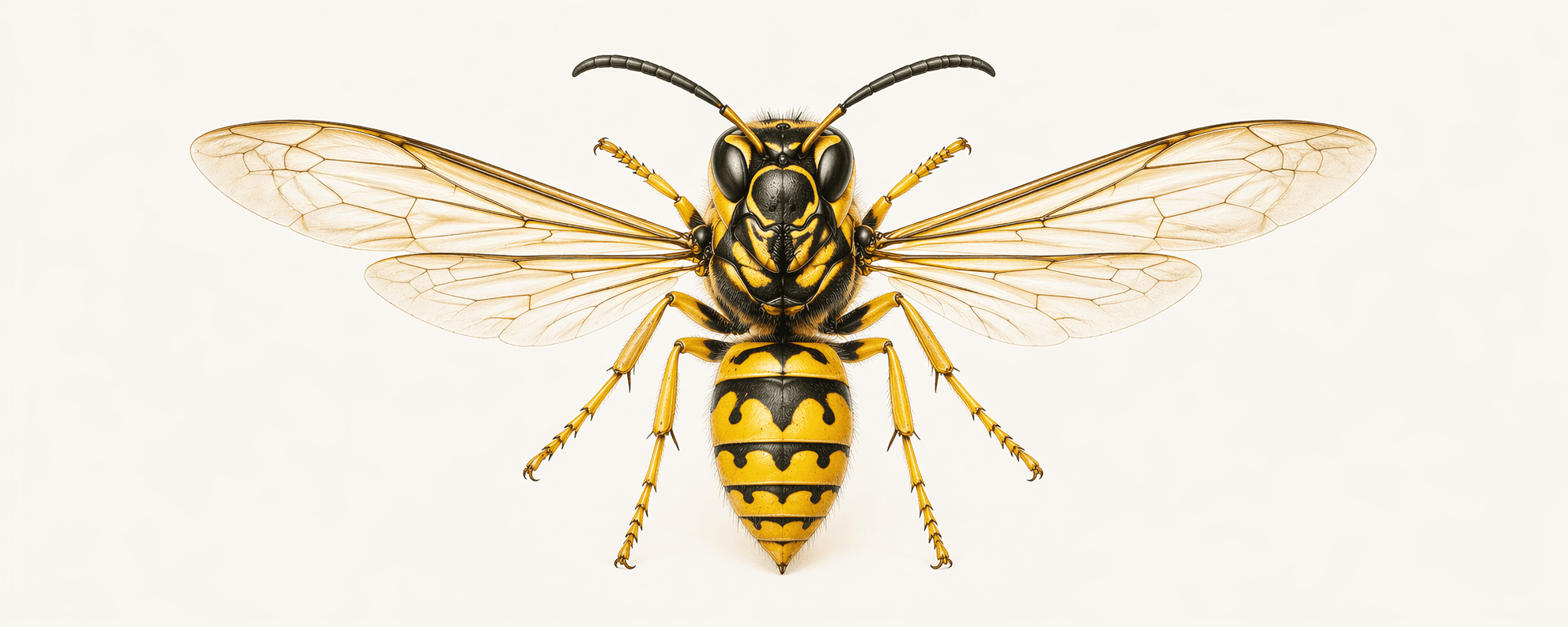
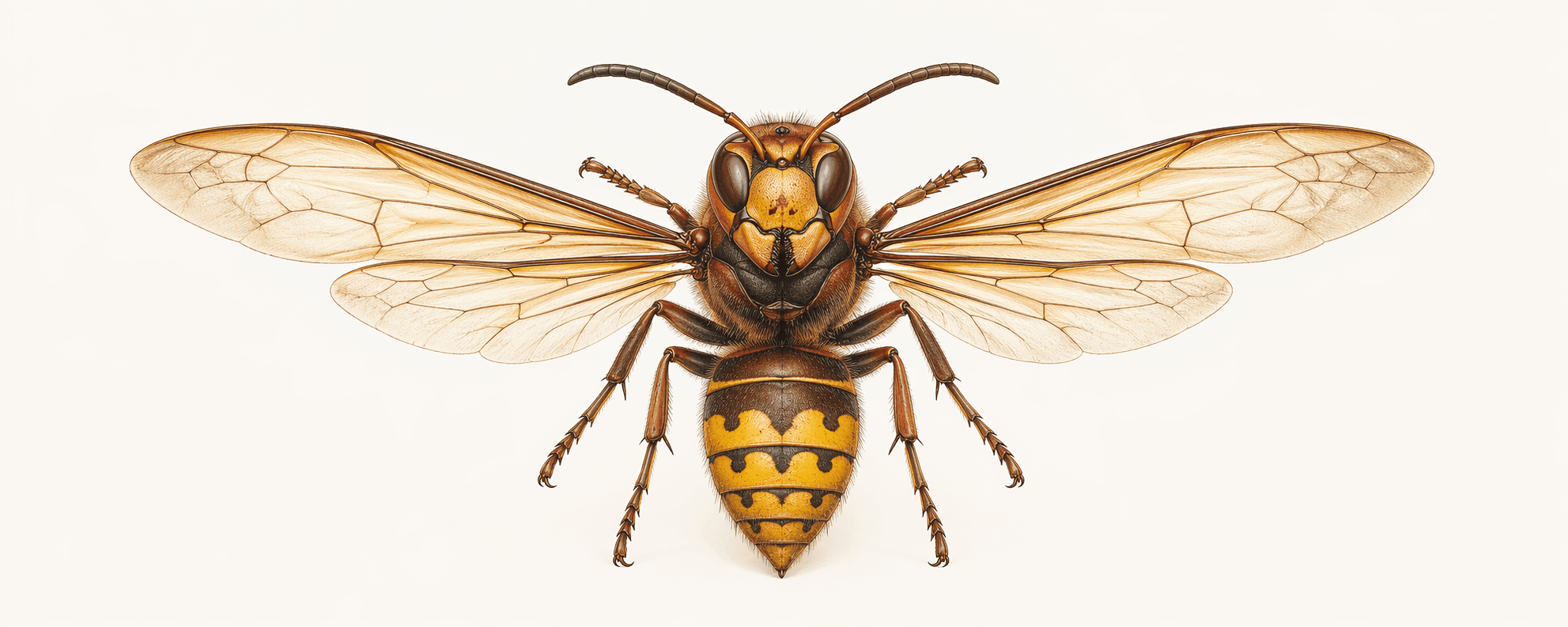
Before talking about destruction, you need to be sure of the species. The Asian hornet stands out from the European hornet by its dark colouring: black thorax, brown abdomen ringed with a broad orange band, and bright yellow leg tips — hence its nickname, the "yellow-legged hornet". It is slightly smaller than its European cousin, but its hovering flight in front of beehives and the sheer density of traffic around the nest make it easy to recognise.
The nest itself is a papier-mâché construction: workers chew wood fibres mixed with saliva to build overlapping beige-brown scales. Three clues set it apart from a common wasp nest:
- The shape: spherical at first, then pear- or drop-shaped as it grows, with a single side entrance — not the wide downward-facing opening typical of the European hornet.
- The size: from an orange in spring to a basketball, or larger, by late summer.
- The location: very often high up in the crown of a tree, but also under a roof overhang, inside a dense hedge, a roller-shutter box or a utility room.
Unsure of the species? A single photo taken from a distance is enough for our technicians to settle the question. And if the insect turns out to be a wasp, the right course of action is different: our guide on what to do about a wasp problem in Monaco covers that scenario in detail.
The annual Vespa velutina calendar: understand the cycle to act at the right time
The Asian hornet lives by a remarkably regular annual cycle under Monaco's climate. That calendar dictates the destruction strategy.
February-March: the founding queens awaken. Queens fertilised the previous autumn emerge from overwintering as soon as temperatures stay above 12-13 °C. On the coast, that can happen as early as mid-February. Each foundress then looks for a sheltered spot to build her first nest alone.
March-April: the primary nest. The queen builds an embryonic nest the size of a golf ball, then an orange. She lays eggs, feeds her first larvae single-handedly and defends her work. At this stage, the colony amounts to one queen and a handful of emerging workers.
May-June: growth. The first workers take over construction and hunting duties. The nest grows fast, and the population climbs from a few dozen to several hundred individuals. In roughly two out of three cases, the colony then relocates to a higher, roomier site.
July-August: the secondary nest at peak activity. This is the most critical period. The secondary nest, often perched 10, 15 or 20 metres up a tree, now houses hundreds and then thousands of workers. Predation pressure on bees and pollinating insects peaks, and so does the colony's defensiveness.
September-October: the foundress diaspora. The colony produces its reproductive individuals — males and future queens. Each mature nest then releases dozens, sometimes hundreds, of potential foundresses which, once fertilised, scatter to overwinter within a radius of several kilometres.
November-January: decline. The old queen dies and the colony fades with the first cold spells. The nest, never reused, slowly disintegrates in the rain and wind.
The key takeaway: the later in the season, the bigger, higher, more populous and more dangerous the nest — and the greater its dissemination potential for the following year.
Primary nest or secondary nest: two radically different targets
In the field, we distinguish two situations that differ in both difficulty and urgency.
The primary nest (March to June) is the size of an orange or a small melon. It almost always sits at head height or low elevation: window ledge, garden shed, pergola, shutter box, accessible eave, shrub. Destroying it is technically simple, quick and radical: by eliminating the founding queen, you remove the entire colony before it truly exists. It is the best risk-to-benefit intervention of the whole year.
The secondary nest (June to November) is another matter entirely. Ranging from basketball size to that of a giant balloon, it frequently crowns pines, palms and cypresses, 10 to 25 metres above the ground. Its population runs into the thousands, its structure contains several stacked brood combs, and destroying it demands long-reach application equipment — in our case a 20-metre telescopic pole — plus a full protective suit.
One detail often misleads homeowners: a primary nest abandoned after relocation can remain in place, empty, while the colony thrives thirty metres away in a tree. Spotting a small nest therefore never removes the need for a perimeter inspection — which is precisely what our diagnosis is for.
Why every destroyed nest counts: the foundress arithmetic
Destroying an Asian hornet nest is not just a matter of immediate comfort or safety. It is an act of population control whose effect is measured the following year.
A mature secondary nest produces on average several hundred future foundresses in autumn. Not all will survive the winter — predation, cold, parasites and competition eliminate a large share — but specialists consistently observe the same thing: every mature nest that completes its cycle spawns several new viable colonies the following season, within a dispersal radius of several kilometres.
The equation is therefore simple:
- A nest destroyed in April (primary stage) = a colony removed before any impact, with a minimal intervention.
- A nest destroyed in July-August (secondary stage, before reproductives are produced) = thousands of bee predators neutralised and, above all, hundreds of foundresses that will never come into being.
- A nest destroyed too late, in November = very limited benefit: the foundresses have already left to overwinter, and the damage for next year is done.
On a territory as dense as Monaco and its surroundings, where hanging gardens, green roofs and parks interlock, this arithmetic matters enormously: a single ignored nest on one plot can seed an entire neighbourhood. Acting fast is not overzealous — it is the only strategy that works against an invasive species reproducing at this rate.
When to have a nest destroyed: the optimal intervention windows
The golden window: April-May. The primary nest is small, low and sparsely populated. The intervention takes less than an hour, the risk of multiple stings is low, and the seasonal impact is maximal since the queen is eliminated. If you spot an orange-sized structure with regular comings and goings in spring, do not wait: it is the best moment of the entire year to act.
The strategic window: July-August. The secondary nest is at peak activity but has not yet released its reproductives. Destroying it at this stage immediately protects people and nearby hives, and cuts off the autumn dispersal. This is when our pole interventions are most frequent.
The catch-up window: September-October. Intervention remains worthwhile — some reproductives have not yet left the nest, and the danger to residents persists as long as the colony is active — but every passing week reduces the ecological benefit.
The time of day matters too. We prefer to intervene early in the morning, in the evening or at dusk, when most workers have returned to the nest: the treatment then reaches the maximum number of individuals and limits the number of orphaned hornets wandering the neighbourhood in the following days.
And if the nest overhangs a building entrance, a playground, a restaurant terrace or a swimming pool? Seasonal windows give way to urgency: our 24/7 emergency service allows same-day neutralisation whenever people's safety is at stake.
Why DIY destruction is out of the question (and genuinely dangerous)
Every season brings serious accidents linked to improvised destruction attempts. Three factors make the exercise objectively unfeasible for a private individual.
Collective aggression. The Asian hornet defends its nest in a coordinated way. Any vibration, impact, jet of water or aerosol spray on the envelope triggers a mass sortie of dozens to hundreds of defenders, capable of chasing an intruder for several dozen metres. Unlike a bee, each hornet can sting repeatedly, and its stinger penetrates most ordinary clothing, gardening gloves included. Venom sprayed towards the eyes has been documented. A swarm attack can cause massive envenomation or anaphylactic shock — including in people with no previous history of allergy.
Height. A secondary nest 15 metres up a pine combines two major risks: falling, and being attacked while balancing precariously. A ladder leaned against a trunk, a jury-rigged pole, a water jet from a rooftop: every accident scenario we know of starts that way. No nest at height is worth risking a fall.
The biocide and its application. Off-the-shelf aerosols have neither the reach, nor the power, nor the persistence required: they irritate the colony more than they destroy it, and a nest "treated" this way remains active in the vast majority of cases. The professional insecticides we use are restricted to certified applicators — our team holds Certibiocide N°121134 — precisely because their handling, dosing and injection into the heart of the nest require specific training. Misused, they endanger the applicator, pets and neighbouring pollinators.
The conclusion is self-evident: faced with an Asian hornet nest, the only useful thing a private individual can do is move away, cordon off the area and call a professional.
Our 4-step destruction protocol
Years of fieldwork across Monaco's terrain — terraced gardens, historic façades, overhanging pine groves — have allowed us to standardise a four-step protocol.
Step 1: remote photo diagnosis. You send us one or more photos of the nest and its surroundings, even taken from afar. Our technicians confirm the species, assess the stage (primary or secondary), the height, access routes and site constraints — proximity to a hive, a school, a busy street. This diagnosis lets us scope the intervention before we even arrive and provide you with a free, no-obligation quote.
Step 2: full-suit intervention with a pole reaching 20 metres. The technician dons a certified anti-hornet suit — heavy fabric, mesh hood, reinforced gloves — then injects the professional biocide directly into the heart of the nest using a telescopic pole reaching 20 metres. Injection into the centre of the brood combs guarantees destruction of the queen, larvae and workers present, while foragers still in flight are contaminated on their return and complete the effect within hours. The perimeter is secured throughout the operation.
Step 3: the check at day +8. About a week after treatment, we verify the total absence of activity: no residual flight, no resumption, no satellite nest in the perimeter. This deferred check is the only serious guarantee that a colony is truly extinct — a nest can seem silent for 48 hours and then restart if the treatment failed to reach the brood.
Step 4: removal of the empty nest. Where the configuration allows it, we detach and remove the deserted envelope. This is not just about aesthetics: a nest left in place keeps emitting olfactory signals, can expose birds to biocide residues, and its gradual decay needlessly worries the neighbourhood. Removal brings the intervention to a clean close.
This protocol applies equally to the small primary nest under a pergola and to the secondary nest crowning a palm tree — only the means of access change, as we explain in our article on nests at height treated with the 20-metre pole.
Should you report the nest and wait, or act directly?
Many homeowners assume an Asian hornet nest must first be "reported" somewhere and that collective action will follow. In practice, participatory reporting schemes mainly serve to map the species: they are valuable for scientific monitoring, but they trigger neither a guaranteed timeframe nor systematic destruction, and responsibility for a nest on private land rests with its occupant.
The private route offers three decisive advantages:
- Speed: an intervention can be scheduled within 24 to 48 hours — or the same day in case of immediate danger — whereas a waiting-list process can leave a nest active for weeks, precisely those in which it produces its foundresses.
- Professional biocide injected into the heart of the nest, incomparably more effective than a surface treatment, with a results check at day +8.
- Traceability: intervention report, applicator certification, re-treatment guarantee — all useful for a co-owned building, a property manager or a hotel operator.
Nothing prevents you from also contributing to participatory platforms to enrich regional mapping: the two approaches are complementary. But for the neutralisation itself, going directly to a certified professional remains the safest and fastest route.
A targeted destruction that protects bees and the ecosystem
Destroying an Asian hornet nest is, in itself, a positive act for biodiversity: a single colony consumes several kilos of insects per season, a large share of which are honeybees and wild pollinators. But the destruction method must not cause more damage than the nest itself.
Our approach rests on three principles:
- Targeted injection rather than broad spraying. The biocide is delivered inside the envelope, in direct contact with the brood. No cloud of product drifts towards flowering plants, vegetable gardens or neighbouring hives.
- Carefully chosen timing. By intervening at dawn or dusk, when pollinators are not foraging and hornets are inside the nest, we maximise effectiveness while minimising the exposure of non-target species.
- No indiscriminate trapping. Sugary bottle traps, often recommended by word of mouth, actually capture a majority of beneficial insects for a handful of hornets. We only deploy selective devices, in tightly managed spring trapping, and only when the context justifies it.
Whenever an apiary is nearby, we systematically adapt positioning, timing and technique. Protecting bees is not a nice-to-have: it is the very purpose of the fight against Vespa velutina.
After the destruction: monitoring, prevention and spring vigilance
The story does not end when the nest comes down. Three reflexes extend the effectiveness of the intervention.
Watch the perimeter for two weeks. A few straggler workers may circle the former site for several days: this is normal and poses no significant danger — they disappear on their own. However, clustered, persistent activity at another spot in the garden may betray a second nest — report it to us; the day +8 check exists precisely for that.
Reduce the site's attractiveness. Seal unused roller-shutter boxes, screen off access to attics and utility rooms, trim dense hedges before spring: each is one less potential shelter for next year's foundresses.
Inspect early the following spring. From March to May, a quick tour of eaves, pergolas, sheds and garden trees lets you spot primary nests at their "orange" stage — the exact moment when their destruction is simplest and ecologically most cost-effective.
A nest spotted, a doubt about suspicious activity, a brown ball revealed in a tree after leaf fall? Send us a photo: the diagnosis is immediate, the quote is free, and our certified team operates throughout the Principality and its surroundings, from the small primary nest on a balcony to the secondary nest perched 20 metres up. With the Asian hornet, the only irreversible mistake is waiting.
Zones served in Monaco and on the Riviera
We operate in particular on Saint-Roman and Cap-d'Ail.
Frequently asked questions
- When should an Asian hornet nest be destroyed?
- As early as possible. The ideal window is April-May, when the orange-sized primary nest is low and sparsely populated: removing it eliminates the queen and the entire future colony. In summer the secondary nest is large and high up, but destroying it before autumn remains essential to prevent the foundresses from dispersing.
- Can you destroy an Asian hornet nest yourself?
- No, it is strongly discouraged and dangerous. The colony defends its nest collectively: dozens to hundreds of defenders, possible multiple stings, risk of anaphylactic shock. Add to that the height (often 10 to 20 metres) and the use of a professional biocide restricted to certified applicators. The only safe course is to move away and call a professional.
- What is the difference between a primary and a secondary nest?
- The primary nest (March-June) is orange-sized and sits at low height: window ledge, shed, pergola. The secondary nest (June-November) reaches basketball size and often perches 10-25 metres up a tree, with thousands of individuals. The former is easy to destroy; the latter requires a telescopic pole and a full protective suit.
- Why is it important to destroy each nest quickly?
- Because a mature nest releases hundreds of future foundresses in autumn which, once fertilised, will create new colonies the following year within a radius of several kilometres. Each nest destroyed before that stage therefore amounts to many nests prevented the next season. It is a genuine arithmetic of controlling an invasive species.
- How does your destruction intervention work?
- In four steps: remote photo diagnosis to confirm the species and assess the nest; intervention in a full protective suit with biocide injected into the heart of the nest via a telescopic pole reaching up to 20 metres; a check at day +8 to verify there is no resumption; then removal of the empty nest where the configuration allows.
- Does destroying the nest protect bees?
- Yes. A single Asian hornet colony consumes several kilos of insects per season, many of them bees and pollinators. Destroying the nest directly reduces that predation. We use targeted injection inside the nest, with no scattered spraying, at times when pollinators are not foraging, in order to preserve nearby hives and the ecosystem.