July 27, 2026 · 15-minute read
Hornet Emergency Before a Wedding: Securing an Outdoor Event
Hornet or wasp emergency before a terrace wedding in Monaco or on the Riviera? Intervention at D-1 or on the very morning, new-generation chemical-free traps, telescopic pole up to 20 m, coordination with wedding planner and caterer: the complete protocol for a pest-free, serene open-air reception.
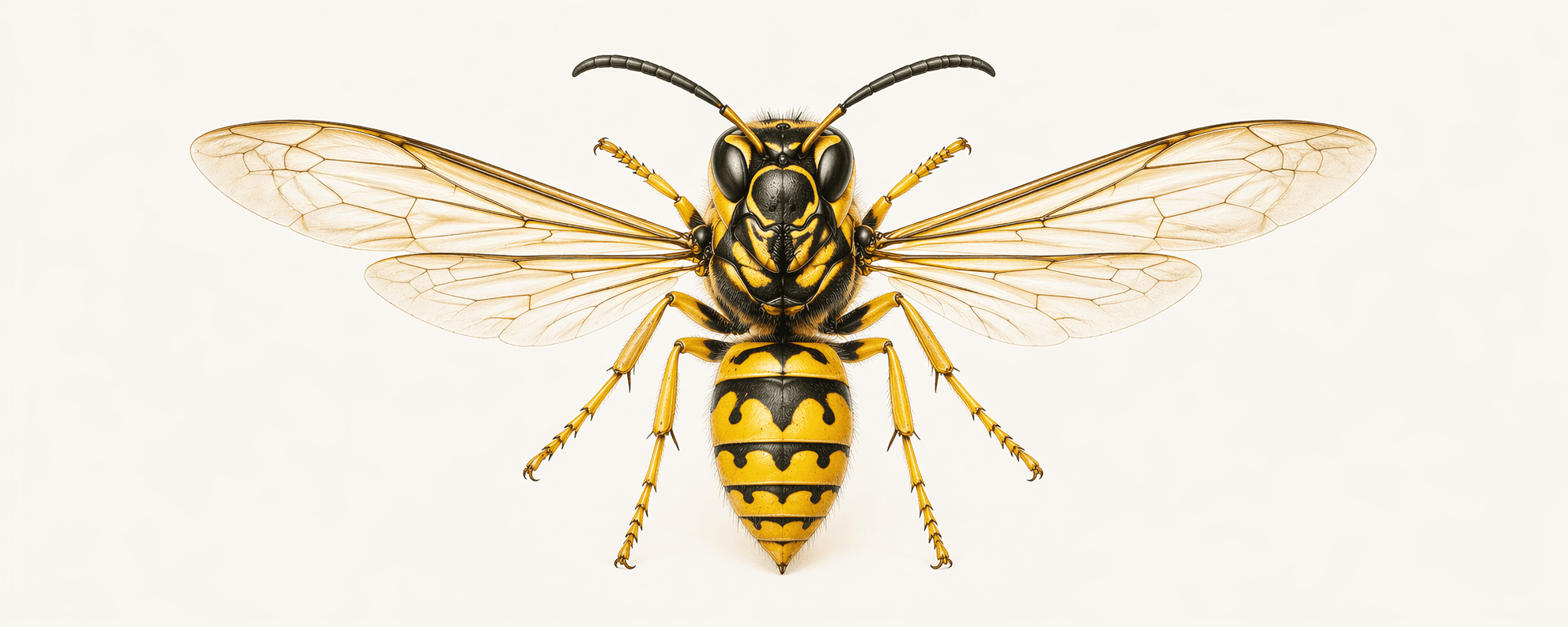
A flower arch facing the sea, tables draped in white beneath the olive trees, a tiered cake waiting for dessert: the setting of an outdoor wedding on the Riviera looks flawless. Then a wasp lands on the bride's glass, a second one circles the buffet, and within ten minutes the whole guest list is talking about it. Every summer, sumptuous receptions tip into crisis management for a reason nobody had written into the production schedule: stinging insects. Wasps and hornets are drawn to exactly what makes an open-air event a success — sugar, protein, perfume, pale colours, light. The good news: a hornet emergency before a terrace wedding can be handled, even the day before or on the very morning, with methods that put no chemicals anywhere near your guests. Here, step by step, is how to secure an open-air reception with a pest-control approach designed specifically for events.
The outdoor wedding dream and its blind spot
On this coast, the warm season concentrates most of the weddings, birthdays, charity galas, corporate cocktails and launch dinners held outdoors. Villa terraces, terraced gardens, rooftops, private beaches, lawns facing the sea: these exceptional settings all share one characteristic that organisers underestimate — they sit in the middle of the hunting territory of wasps and hornets at precisely the moment when colonies reach their population peak.
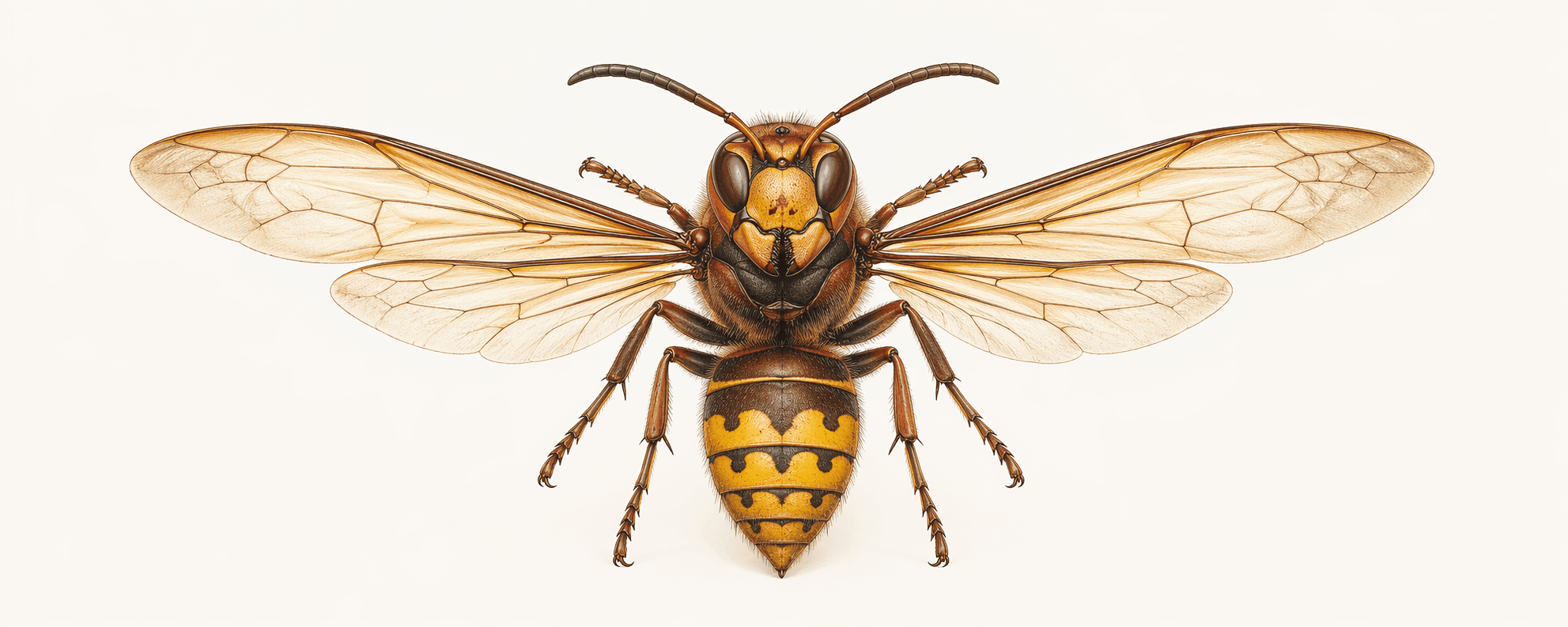
From June to October, a colony of wasps numbers several thousand workers foraging relentlessly within a radius of several hundred metres around the nest. Asian hornets, for their part, hunt more than a kilometre from their secondary nest, often perched at the top of a pine or a cypress. In other words, even if your reception venue itself is impeccable, a nest on a neighbouring plot, in an embankment or in a tree on the property line is enough to send a continuous stream of foragers towards your buffets.
That is the blind spot: people plan for the weather, the seating chart, the sound system, the caterer, the flowers — but almost never for a pest survey of the site. Yet a single wasp in a champagne coupe can cause a sting in the throat; an allergic guest can develop a severe reaction within minutes; and hornets above a dance floor are enough to empty a terrace. A successful outdoor event therefore starts with a simple question, ideally asked two to three weeks before the date: what do we know about wasp and hornet activity on this site and around it?
Why wasps and hornets crash your reception
Understanding what attracts these insects explains why, from their point of view, a reception is an exceptional windfall. In late summer, the wasps' diet shifts: there are fewer larvae to feed with protein, and the workers turn massively to sugars. A reception then concentrates in one place everything they are looking for.
Sweet attractants first: champagne coupes and cocktails, fruit juices, lemonades, syrups, baskets of ripe fruit, the wedding cake, macarons, ice cream, chocolate fountains. A flute left in the sun for ten minutes becomes an involuntary wasp trap — except that the trap is standing in the middle of your guests. Soft drinks are a particular problem: the insect crawls into the glass or the can, invisible, and the sting comes with the next sip.
Then protein: the buffet's meat platters, seafood displays, charcuterie, smoked salmon, sushi. Especially early in the season, wasps carve off fragments of protein to feed the brood, and a buffet set up an hour before service offers them an open-air self-service counter. Asian hornets, formidable predators, patrol around anything that concentrates other insects — including the wasps drawn to your dishes.
Finally, factors nobody thinks of: white tablecloths and pale outfits reflect light and act as visual beacons; heady perfumes, hairsprays and certain sunscreens mimic floral signatures; the floral arrangements themselves, omnipresent at a wedding, attract foragers; evening lighting draws night insects which in turn draw predators. Add the catering station's bins, the collected glasses and the water of the neighbouring pool, and you have a complete ecosystem of attractants. The subject of water features is so recurrent that we devoted a detailed field report to wasp nests around pools and pool houses.
Assessing the risk in the days before: the tell-tale signs
Two to three weeks before the event, an inspection visit makes the risk measurable instead of leaving it to chance. Some signs can be spotted without any equipment, provided you know where to look.
The first indicator is traffic. A steady coming-and-going of insects towards a fixed point — a hole in a wall, an air vent, a roller-shutter box, a planter, a garden shed, the crown of a tree — almost always betrays an active nest. Ten passes per minute at the same spot are not a coincidence. The second indicator is behaviour around water: in hot weather, wasps and hornets come to drink in numbers on pool copings, fountains and plant saucers. The third is the presence of hornets hovering in front of shrubs or flowering areas: that is characteristic hunting behaviour.
A professional inspection goes further: examination of attics, eaves, shutter boxes, dry-stone walls, dense hedges, tall trees, utility pits and service rooms; tracking of flight paths with binoculars to trace nests beyond the visible property; mapping of the event's sensitive zones — cocktail area, buffets, children's corner, dance floor — against the sources identified.
This assessment leads to a proportionate action plan. Sometimes everything is fine and a few preventive measures suffice. Sometimes a nest is discovered fifteen metres from the future cocktail area, and a neutralisation must then be scheduled under good conditions rather than improvised at the last minute. In both cases, the organiser gains what matters most in the run-up to an event: visibility. A free quote request with the event date and a few photos of the site is already enough to orient the diagnosis.
Emergency at D-1 or on the morning itself: our timed protocol
The reality of the events business is that the problem is often discovered at the worst moment: while the tents are going up the day before, during buffet set-up at dawn, or when the site manager notices a swirl of insects above the ceremony area. It is precisely for these situations that our 24/7 emergency service is designed, with a protocol specific to events.
At D-1, the window is still comfortable. The typical intervention takes place at the end of the day or at night, when the colony is gathered in the nest and its aggressiveness is at its lowest. The nest is treated by targeted injection directly into its core, with no product dispersed over the reception areas. Night treatment has a decisive advantage for an event: by morning, activity around the nest has ceased, the nest can be removed where accessible, and the caterer's teams can set up the buffets with nothing flying overhead. The following hours also give the few lingering foragers time to disappear.
On the morning itself, the protocol changes in nature: it is no longer only about neutralising, but about securing within a counted time. The intervention then combines treatment of the nest if it is located and accessible, immediate placement of trapping devices on the perimeter to intercept incoming insects, neutralisation of the micro-attractants on site — bins, the catering station's waste areas, standing water — and discreet marking of the zones to watch. The goal is to reverse the attractiveness gradient: make the perimeter of the site more interesting than your tables.
Two golden rules govern these express interventions. First, never any blanket spraying on a reception venue: chemically treating a terrace a few hours before dinner is served on it would be professional misconduct. Second, discretion: plain workwear outside the technical phases, coordination with the site manager to pass before the vendors arrive, and complete withdrawal before the first guests. A hornet emergency on a wedding terrace is managed like the rest of the event: without the guests noticing a thing.
New-generation chemical-free traps: protecting without treating
This is the heart of our approach for events, and what sets it apart from conventional solutions: the protection of an open-air reception rests first and foremost on new-generation traps, entirely chemical-free in the areas occupied by guests.
The principle is selective interception. Traps with calibrated food attractants — sweet and protein lures formulated to be more attractive than your buffets — are positioned in a belt around the site, away from the reception spaces, on the approach routes identified during the diagnosis: on the nest side if a nest remains out of reach, along the hedges, near the bins, downwind. Wasps and hornets on approach meet the trap before the tables and concentrate there. Selectivity is a key point: the design of the entrances and the choice of attractants sharply limit the capture of bees and useful pollinators, which are not targeted.
The absence of biocide in the reception areas changes everything for an event. No residue on tables, linens or decorative planting; no waiting period between the intervention and service; no odour; no awkward question from a guest or a vendor about what was sprayed where plates are being laid. Biocidal treatments stay where they belong — the neutralisation of the nests themselves, at a distance, under certibiocide No. 121134 — while the guests' space is protected by a physical and behavioural barrier.
These devices are ideally deployed a few days before the date, giving the trapping belt time to establish its diversion effect, but placing them on the morning itself remains possible and useful. They are then discreetly collected after the event. For a wedding, we integrate them into the overall site plan so that no trap is visible from the photo areas — the aesthetics of a reception are part of the brief just as much as safety.
A nest at height: the telescopic pole up to 20 metres
The scenario organisers dread most is also the most frequent on the Riviera: a nest of Asian hornets spotted at the top of a stone pine, a cypress or a palm overlooking precisely the reception area. At fifteen or twenty metres up, the nest seems out of reach, and some providers give up or propose heavy equipment — cherry picker, tree surgery — incompatible with a staged garden at D-1.
Our technical answer is the telescopic treatment pole, capable of reaching a nest up to twenty metres high from the ground. The operator, in a full protective suit, positions the injection head at the nest entrance and treats the colony at its core, with no scaffolding, no lift platform, no damage to trees or borders. For an event site, the benefits are immediate: no machinery on the lawns, no branch cut out of the scenery, no ground footprint in the zones where tents and furniture are being installed, and an intervention that can be carried out at night, the day before the event, when the site is empty.
Height is therefore no longer a reason to give up or to postpone. A nest overlooking the terrace can be neutralised at D-1 at dusk, the nest removed where possible, and the site handed back to the crews the next morning. In the terraced configurations typical of this coast — sloping gardens, narrow access, dense vegetation — this capacity to work from the ground often makes the difference between an event that goes ahead and a fallback plan indoors.
One point of caution deserves repeating: a nest at height must never be approached by the venue staff or the vendors, not even "just to have a look". A summer colony numbers thousands of individuals that defend their nest violently as soon as it vibrates. The instruction to give everyone is simple: spot it, photograph it from afar, call our 24/7 emergency line, and do not touch it.
Coordinating with the wedding planner and the caterer: a shared checklist
Successful pest protection at an open-air reception is teamwork. We operate as one technical vendor among others, integrated into the production schedule, and this coordination follows a proven checklist.
With the organiser or the wedding planner, upstream: hand-over of the site plan — ceremony, cocktail, dinner, dance floor, children's corner — to cross-reference the sensitive zones with the risk map; definition of intervention slots compatible with deliveries, rehearsals and technical run-throughs; designation of a single point of contact for the day itself; and a weather check, because wind and heat change insect behaviour and trap positioning.
With the caterer, simple measures multiply the effectiveness of the set-up: dress the buffets at the last moment and keep cloches and platters covered until service; serve sweet drinks to order rather than leaving them out in prolonged self-service; favour covered cups or straws for the children's soft drinks; clear tables continuously rather than at the end of each sequence; keep the catering station's bins tightly closed and downwind; isolate the dishwashing area. None of these measures is visible; all of them reduce attractants at the critical moment.
On the day, our role can extend into stand-by duty: a technician reachable, or even present in the background at large formats, able to react within minutes if unusual activity appears — a trap to reposition, a secondary hotspot to treat away from the guests, an instruction to adjust with the head waiter. For professional organisers who run events all season, this integration is readily formalised as a recurring partnership: same contacts, same standards, sites known in advance. A free quote request can cover a single event as well as a full season.
Field reports: Riviera villas in event mode
A few real situations on coastal properties illustrate better than any speech the variety of cases and responses.
First case: a wedding for one hundred and fifty guests in the garden of a villa overlooking the sea. At D-2, while the reception tent was going up, the technical crew reported large numbers of hornets above the cocktail area. The end-of-day diagnosis revealed a secondary nest at around eighteen metres, in a pine on the property line. Intervention that same evening with the telescopic pole, removal of the nest the following morning, a trapping belt placed on the perimeter as a precaution: the cocktail was held exactly where planned, and the newlyweds never knew there had been an issue.
Second case: a birthday party by a pool, with a fruit buffet and an ice-cream bar — the worst possible accumulation of attractants. The inspection at D-7 revealed no nest on the property, but sustained wasp traffic coming from an inaccessible neighbouring plot. The response was entirely chemical-free: a belt of new-generation traps placed at D-3 on the approach routes, catering instructions on drink service, buffets kept covered. On the day, activity at the tables was residual. This kind of configuration around pools matches what we describe in our article on wasp nests in pool and pool-house areas.
Third case: a gala dinner set on a terrace, the alert raised on the very morning by the site manager — wasps emerging from a dry-stone wall a few metres from the tables. Localised treatment of the nest in the wall early in the morning, the perimeter neutralised and checked by midday, traps in cover, evening service without incident. The common lesson of these three cases: the earlier the alert, the simpler the response — but even on the morning itself, a clean solution exists.
Securing without being seen: discretion as the standard
At a high-end private reception, the manner matters as much as the result. Nobody wants a technical intervention to become a topic of conversation, or a protective suit to cross the background of the ceremony photos.
Our event interventions therefore follow strict rules of discretion: time slots set outside guest presence and, as far as possible, outside vendor presence; an unmarked vehicle and plain workwear for the scouting and installation phases; trapping devices placed out of sightlines and photo angles; communication channelled through a single contact — organiser or site manager — who decides what is said, to whom, and when. Confidentiality extends to the venues themselves: we name neither properties nor people, and the field reports shared here are systematically anonymised.
This requirement reflects a broader conviction: successful pest control at an open-air reception is the kind that goes unnoticed. No spray cloud, no odour, no visible equipment, no anecdote — just a terrace where people dine peacefully on a summer evening, which, on this coast and in this season, owes nothing to chance.
In summary: the ideal timeline for a serene event
To fix ideas, here is the timeline we recommend to anyone organising an outdoor wedding, birthday or gala on the Riviera.
At D-21: inspection of the site and its surroundings, location of nests and flight paths, mapping of sensitive zones, action plan and free quote. At D-7: neutralisation of the identified nests — at night, with the telescopic pole where necessary — and treatment of structural points such as walls, attics or shutter boxes. At D-3: installation of the belt of new-generation chemical-free traps around the reception areas, briefing of the caterer and validation of the service instructions. At D-1: general check of the site, inspection of the traps, a final pass over water points and waste areas. On the day: stand-by duty, a single point of contact, and a response within minutes through the 24/7 emergency service if anything unexpected arises.
And if you are reading these lines the day before your event with a nest above the terrace: the ideal timeline no longer exists, but the solution still does. A certified team, a twenty-metre pole, chemical-free traps and a few hours of darkness are enough, in the vast majority of cases, to give your reception its carefree spirit back. That is exactly our job — to learn more about the species involved, our dedicated pages on wasps and hornets detail their biology and our methods.
Zones served in Monaco and on the Riviera
We operate in particular on Monaco-Ville and Jardin Exotique.
Frequently asked questions
- Can you intervene the day before or on the very morning of a wedding?
- Yes, that is exactly what our event protocol is built for. At D-1, we favour a night treatment of the nest, when the colony is gathered and least aggressive, with removal of the nest in the morning. On the morning itself, we combine neutralisation of the nest where accessible, a belt of chemical-free traps on the perimeter and removal of attractants on site. Our emergency service is reachable 24/7.
- Do the chemical-free traps also work against Asian hornets?
- Yes. The new-generation traps use calibrated food attractants, sweet and protein-based, effective on wasps as well as on approaching Asian hornets. Positioned as a belt on the flight paths, they intercept the insects before the tables. They do not replace the destruction of an active nest, but they protect the guest area without any biocide.
- What if the nest is at the top of a tall tree overlooking the reception?
- Do not touch it and call us. Our telescopic treatment pole reaches nests up to 20 metres high from the ground, without a lift platform, without tree cutting and without any footprint on the lawns or the decor. The intervention is preferably carried out at night, the day before the event, and the nest is removed where possible. Height is no longer a reason to postpone.
- What instructions should the caterer follow to limit wasp attraction?
- Simple habits change everything: dress the buffets at the last moment and keep dishes and platters covered until service, serve sweet drinks to order, provide covered cups or straws for children, clear tables continuously, keep the catering bins tightly closed and downwind, isolate the dishwashing area. We brief the caterer's team directly during preparation.
- How long before the event should the site inspection be scheduled?
- The ideal is an inspection two to three weeks before the date: it leaves time to neutralise a nest under good conditions, to place the trapping belt a few days ahead and to brief the vendors. But a shorter lead time remains manageable: our D-7, D-1 and same-day protocols cover every situation, including last-minute discoveries.
- Will the guests notice anything? Is it safe near the food?
- No, and that is a commitment. No biocide is used in the areas occupied by guests: they are protected by chemical-free traps, invisible from the photo areas. Nest treatments are carried out at a distance, at night, under certibiocide No. 121134, before the crews arrive. No residue, no odour, no waiting period before service.