
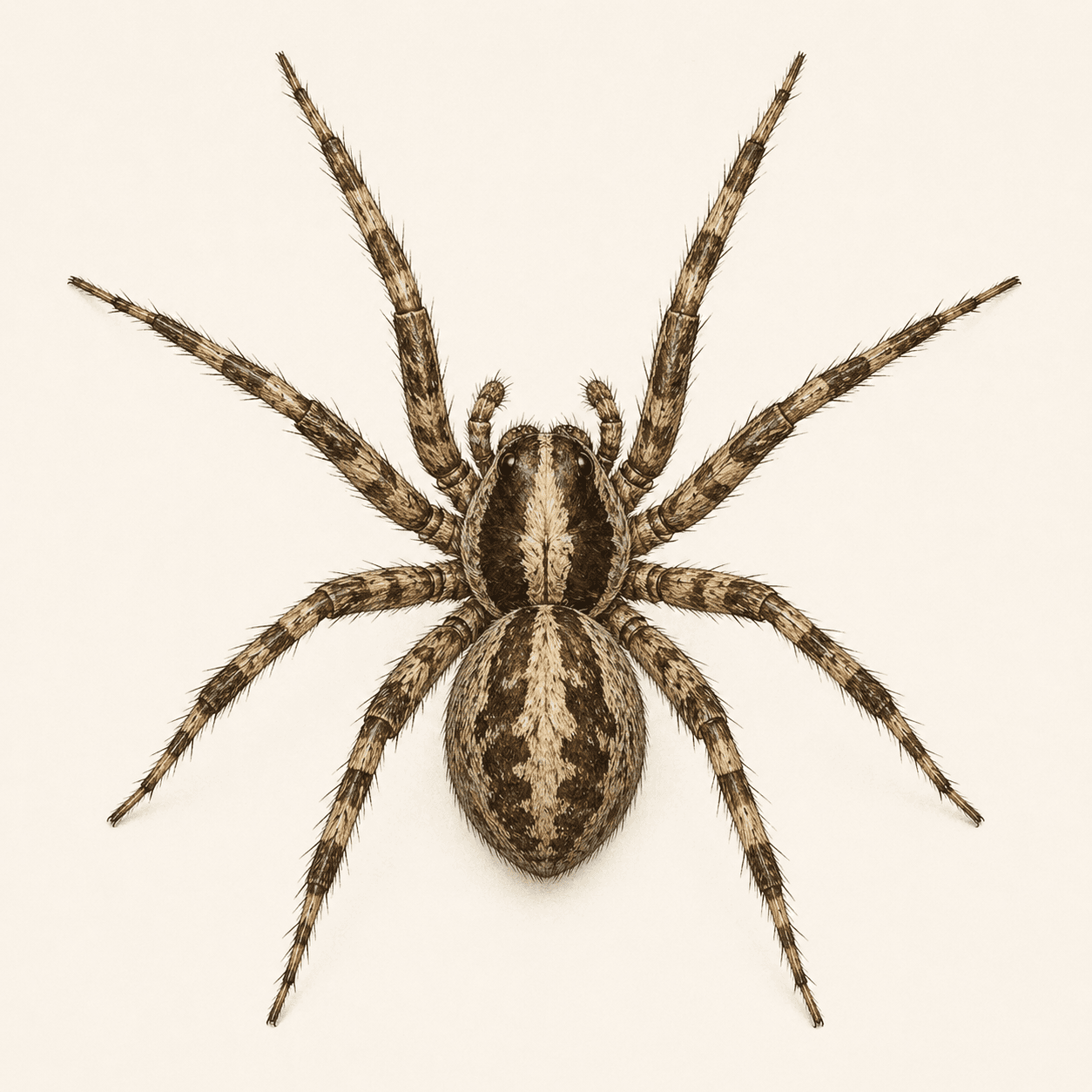
Identifying spiders: the signs that never lie
A spider infestation is not noticed like an invasion of ants or cockroaches — it settles in silently. The clues are nonetheless readable.
- Recurring webs in ceiling corners, under window ledges, behind rarely moved furniture, in the corners of covered terraces and loggias.
- Egg sacs, whitish or beige, spherical, often fixed up high or in a dark recess — each sac can contain several dozen eggs.
- Moults, translucent, stuck to walls or fallen to the floor: a sign of a growing resident population, not an isolated individual.
- Small debris beneath the webs: chitinous remains of prey insects, indicators of an active food chain.
Two species draw particular attention in Monaco. The Mediterranean recluse (Loxosceles rufescens), pale brown, six eyes arranged in three pairs, a violin-shaped mark on the cephalothorax, prefers dry, undisturbed places: cellars, attics, the backs of furniture, storage boxes. The domestic house spider, large and fast, frightens above all by its size but remains harmless. The daddy-long-legs spiders (long-legged spiders), for their part, betray excessive relative humidity in wet rooms or crawl spaces.
Health and material risks
Almost all the spiders present in the Principality are harmless to humans. The real risk is concentrated on a few cases — but it justifies methodical vigilance.
On the health side: - The bite of the Mediterranean recluse is rare but can develop into a local necrotic lesion (cutaneous loxoscelism), requiring medical follow-up if a painful purplish patch appears within 24 to 72 hours. - Allergies to moult proteins occur in sensitised individuals (rhinitis, conjunctivitis) in heavily infested environments — rarely visited villa attics, unventilated wine cellars. - The phobogenic effect is a clinical issue in itself: many requests for MPS intervention come from residents whose arachnophobia compromises the normal use of a room.
On the material side: webs collect dust, spoil matt paintwork, mark facing stones and lime renders, tarnish electrical panels and smoke detectors. In premises open to the public, a visible web in a room is an immediate non-conformity point during a quality or HACCP audit.
Why spiders thrive in Monaco and on the Riviera
The Principality's Mediterranean climate offers arachnids near-ideal conditions: mild winters, high coastal humidity, prolonged absence of destructive frost. Three factors structure the pressure on Monaco buildings.
- An abundant food pyramid. Coastal mosquitoes, flies attracted by beach catering, moths around the night-time lighting of Monte-Carlo — prey abounds. Where there are insects, there are spiders.
- Favourable architecture. Prestigious residences multiply the perfect recesses: roller-shutter housings, service ducts, expansion joints, the dry-stone walls of the gardens of Cap-Ferrat and Roquebrune, service stairs, bin stores, underground car parks.
- A pronounced seasonality. House spiders invade dwellings in late summer and early autumn, during mating. The recluse, for its part, does not migrate — it settles and breeds on the spot, often unnoticed for years.
The districts of La Condamine, Fontvieille and Larvotto, as well as the heights of Beausoleil and Cap-d'Ail, present different risk typologies but comparable technical solutions.
The MPS protocol in five steps
Our spider intervention follows a rigorous sequence, adapted to the building and the client's constraints.
- Entomological diagnosis. Identification of the dominant species (recluse or not), mapping of the colonised areas, location of entry points (vents, thresholds, ducts), assessment of external pressure (vegetation, lighting).
- Complete mechanical vacuuming. Removal of all visible webs, sacs and specimens using HEPA vacuum cleaners. This step, often neglected, mechanically eliminates the eggs and instantly lowers the population.
- Residual perimeter treatment. Micro-diffused application of an approved biocide on the building's outer perimeter, opening frames, ventilation grilles, cellars and plant rooms. A barrier effect over several weeks.
- Targeted treatment of sensitive areas. For the recluse: thorough treatment of the resting areas (behind heavy furniture, skirting boards, storage boxes) with products suited to the species' sedentary behaviour.
- Inspection and certification. Verification visit at fifteen days, adjustment if necessary, delivery of an intervention certificate compliant with Certibiocide requirements.
Mistakes to avoid
Private individuals regularly make the same errors:
- Consumer insecticide sprays: ineffective on spiders, because these walk on surfaces without prolonged contact, unlike classic crawling insects. The active substance does not penetrate sufficiently.
- Sweeping away the webs without treating: the females rebuild within 48 hours and the intact sacs hatch anyway.
- Peppermint essential oil / coffee grounds / conkers: anecdotal repellent effects, no lethal action, no residual effect.
- Crushing a suspected recluse without identification: a bad idea in the event of a later bite, as the species can no longer be confirmed.
- Treating only the interior: spiders come from outside. Without a perimeter barrier, recolonisation is guaranteed.
A typical Monaco case
A contemporary villa on the heights of Roquebrune-Cap-Martin, the owner reporting a family phobia and several recurring webs in the patio, the stairwell and the basement laundry. Our diagnosis identified a large population of house spiders around the periphery (dry-stone retaining walls, highly attractive outdoor LED lighting) and two isolated recluse nests in a storage room containing boxes not moved for more than a year.
Intervention in half a day: complete vacuuming, perimeter treatment of the building on three façades, spot treatment of the storage room, a recommendation to switch the outdoor lighting to amber-spectrum LEDs less attractive to prey insects. Inspection at fifteen days: no web rebuilt indoors, marginal residual outdoor pressure. Quarterly follow-up contract signed, under NDA.
Lasting prevention
Beyond curative treatment, a few habits durably reduce the pressure:
- Vacuum regularly the high corners, skirting boards, backs of rarely moved furniture, shutter housings.
- Rationalise outdoor lighting: favour LEDs with a warm colour temperature (2200-2700 K), install fittings away from openings.
- Seal duct penetrations, ventilation grilles with fine mesh, door thresholds.
- Prune vegetation in direct contact with the façades — spiders often migrate via the branches.
- Treat the prey: mosquitoes, flies, moths. Reducing the insect population reduces the spider population.
- Watch the storage areas: boxes, garages, wine cellars, laundries — inspect and move the containers twice a year.
Regulatory framework and biocides
In Monaco, the use of biocidal products in a professional setting is governed by Monaco regulations, with transposition of the European requirements on active substances. Our technicians hold the Certibiocide N121134 (French standard), mandatory for handling these products in France as in the Principality within the cross-border framework of our Riviera interventions. No spider species present in Monaco is protected. Nor does any fall into the category of regulated invasive alien species. The treatments we implement observe the re-entry times and the usage precautions specific to each formulation, with safety data sheets available on request.
How long, how many visits
For a classic house-spider infestation in a villa or flat, one visit is sufficient in the great majority of cases, with an inspection visit at fifteen days and complete resolution in three to four weeks. For the Mediterranean recluse, whose cycle is longer and whose behaviour is more discreet, we systematically recommend two visits spaced three to four weeks apart, in order to treat the individuals from the post-intervention hatchings. Extensive co-owned buildings, villas with several building blocks, restaurants with covered terraces or hotel establishments fall under a quarterly follow-up contract, better suited to the seasonal resurgence of external pressure.
In any doubt? Our team responds within 2 working hours. +377 37 70 70 02 — or [request a free quote](/devis-gratuit).