
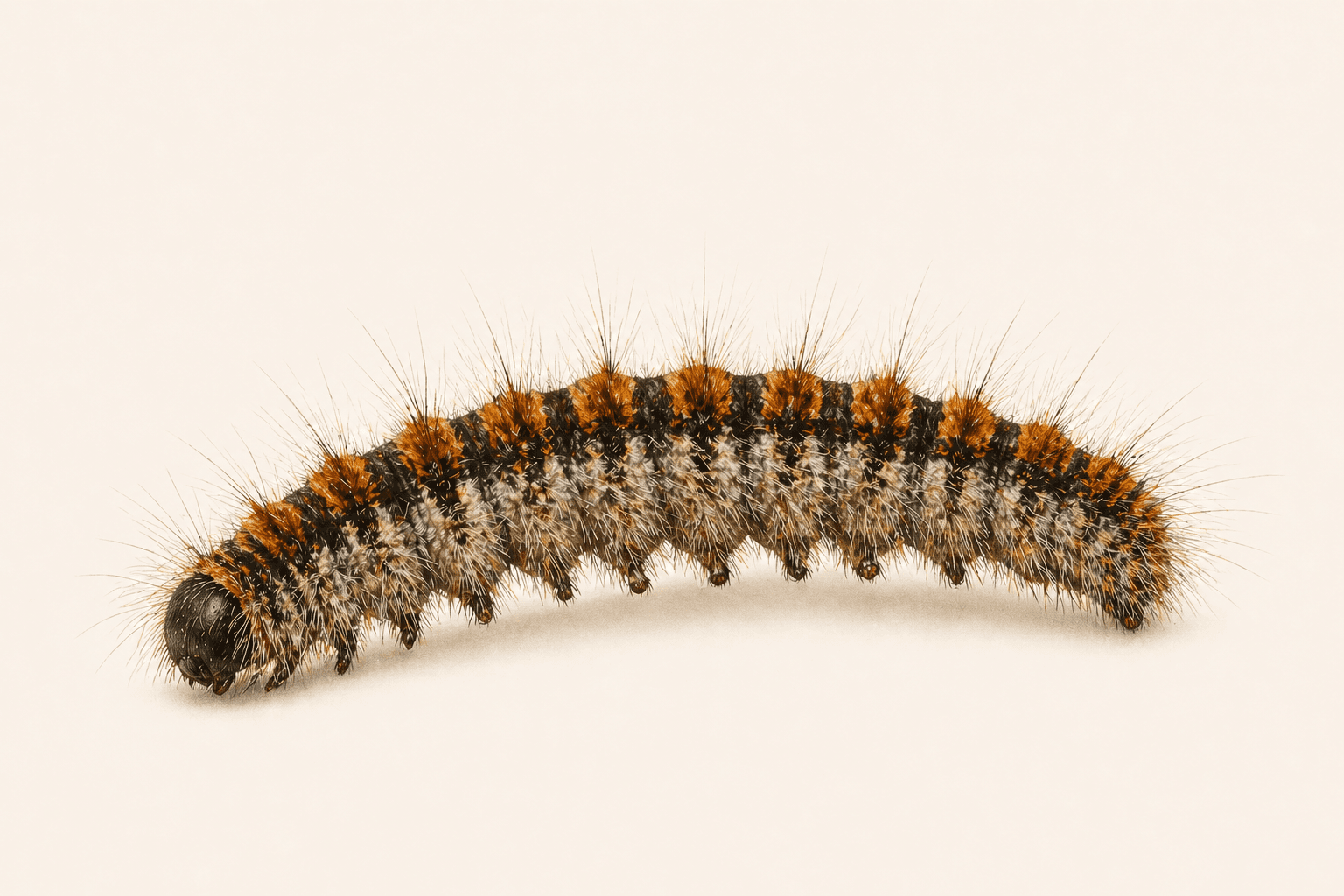
Identifying pine processionary caterpillars: the signs that never lie
The pine processionary caterpillar (Thaumetopoea pityocampa) gives itself away well before the insect itself is spotted. The first clue is the winter nest: a whitish silken pouch, dense, glossy in the sun, attached to the tips of pine branches — mainly Aleppo pine, maritime pine, black pine, and occasionally cedars. These nests appear in autumn and grow throughout the winter. Inside, several hundred larvae await the spring.
Other signals to watch for:
- Reddened or yellowed needles on infested branches, the characteristic "scorched" effect
- Partial defoliation of the pine's crown, visible from a balcony or terrace
- Lines of caterpillars in single file on the ground or on the trunks, generally from February to May depending on exposure
- Cream to brownish moths flying on summer evenings around outdoor lamps
The caterpillars themselves reach 3 to 4 cm, reddish-brown, covered with clearly visible bristles. Never go near them, even dead ones: the urticating hairs remain active for several months, including in an empty nest on the ground. A gardener pruning a pine in June without realising it can trigger a generalised reaction by handling contaminated branches.
Health and material risks
The danger of processionary caterpillars comes not from a sting or a bite but from the urticating micro-darts projected into the air the moment the caterpillar feels threatened. Each larva carries more than half a million of these bristles containing thaumetopoein, a powerful allergenic protein.
In humans, exposure causes:
- Itchy skin rashes, oedemas, persistent patches
- Severe conjunctivitis, corneal ulceration in the event of eye contact
- Respiratory problems, laryngeal oedema and anaphylactic shock in sensitive individuals
- Particularly violent reactions in children who touch or tread on a procession
The veterinary risk is major. A dog that sniffs a caterpillar can, within a few hours, develop tongue necrosis requiring partial amputation. Cats and horses are not spared. This risk alone justifies immediate intervention in any residence with animals.
On the legal side, although no national Monaco obligation specifically targets the lepidopteran, the owner's civil liability is engaged as soon as a third party (visitor, employee, contractor) is injured on their land. For co-owned buildings, inaction over a reported nest exposes the managing agent to a failure in the duty to maintain the common areas.
Why this pest thrives in Monaco and on the Riviera
The Principality and its hinterland offer processionary caterpillars ideal ground for expansion. The mild Mediterranean climate, with short and increasingly less severe winters, allows the caterpillars to continue their cycle without interruption. Where the cold once killed the larvae, they now descend to bury themselves in soil that hardly ever freezes.
Several local factors amplify the pressure:
- A density of ornamental pines in the gardens of Roquebrune-Cap-Martin, Cap-d'Ail, Beausoleil and on the heights of Monte-Carlo
- Neighbouring pine woods of Cap-Ferrat, La Turbie and the Nice hinterland, permanent reservoirs of adult population
- Tree-lined terraces of the buildings of Fontvieille and Larvotto, where a single pine is enough to contaminate several floors
- Measured warming that stretches the moth's activity window and brings the flights closer to residential areas
The seasonality is strict: moth flight from June to September, summer egg-laying, nest formation in autumn, procession down to the ground from February to April. Each season calls for a different intervention method, which makes improvisation particularly risky.
The MPS protocol in five steps
Certibiocide N121134, Monaco Pest Solutions applies measured control, calibrated according to the season of discovery and the sensitivity of the site.
- On-site diagnosis — Mapping of infested pines, counting of nests, assessment of height, exposure, presence of children or animals, proximity to thoroughfares. We also identify the species not yet affected but to be watched.
- Mechanical nest removal — From November to February, cutting and then the secure destruction of the nests by cherry picker or roped climbing. Personnel work in full protective suits, FFP3 masks and sealed goggles. The branches are bagged and then incinerated.
- Biological treatment with Bacillus thuringiensis — Targeted spraying of Bt kurstaki from September to November, when the young caterpillars are actively feeding. An approved biocide, leaving no residue for non-target wildlife, the bacterium affects only pest lepidoptera.
- Installation of pheromone traps in a ring around the property in spring-summer, to capture the male moths and interrupt the reproductive cycle the following year.
- Collar eco-traps fitted to the trunk in late winter to intercept the descending processions without any chemical intervention.
Each intervention is the subject of a detailed report and a follow-up inspection three to six months later. Contractual NDA discretion is systematic.
Mistakes to avoid
Improvisation costs dearly, and sometimes more than money. Here are the most frequent errors we encounter on the Côte:
- Shooting at the nests with a water jet or an air rifle: the dispersal of the urticating hairs over several dozen metres contaminates the whole plot and renders the garden unusable for weeks
- Burning a nest on the spot: produces an aerosol of active bristles that the wind carries towards neighbouring homes
- Cutting the branch without protection and putting it out with the household waste: contaminates the bin store and exposes the collection workers
- Using a consumer insecticide sprayed on the foliage: ineffective against the larvae protected by the nest's silk, toxic for pollinators and garden wildlife
- Waiting for spring in the belief that the caterpillars will leave on their own: this is precisely the moment when the risk explodes, during the descent to the ground
The other mistake, more subtle, is to treat only a visible pine while ignoring the neighbouring or adjoining trees. An undetected nest at the neighbour's systematically reinfests your plot the following year.
A typical Monaco case
An exceptional villa on the heights of Roquebrune-Cap-Martin, four umbrella pines at the poolside, a family with two young children and a Labrador. The owner contacted us in late January after spotting what he thought was "a line of worms" on the lower terrace.
Diagnosis within 48 hours: seven nests spread over three trees, including two more than fifteen metres up, with a first procession already beginning. Intervention in two stages the same week — roped climbing for the high nests, cherry picker for the accessible ones, complete bagging, disposal through the regulated waste channel. Eco-traps fitted to the trunks the next day.
Return the following spring: installation of pheromone traps from June around the pool and along the lower boundary. Bt treatment in October across the whole tree canopy. No recurrence observed during the annual inspection visits. The dog regained full access to the garden in under three weeks.
Lasting prevention
Controlling processionary caterpillars is not planned by the year but over a complete life cycle. A few reflexes structure effective prevention:
- Annual inspection of the pines in early autumn, before the nests reach visible size
- Systematic pheromone trapping from June to September on already infested properties or in at-risk areas
- Choice of species: when planting landscaping, prefer non-host species (olive trees, Provence cypresses, holm oaks) rather than exposed ornamental pines
- Neighbourhood coordination: synchronising treatments with adjoining properties multiplies the effectiveness
- Controlled sanitary pruning to thin out dense crowns and facilitate early detection
MPS offers annual maintenance contracts covering inspection, trapping, preventive Bt treatment and emergency intervention within 24 hours during the at-risk season.
Regulatory framework
In mainland France, the pine processionary caterpillar has, since 2022, been classified as harmful to human health under the Public Health Code, requiring forest and public landowners to prevent its proliferation. Monaco has no explicit equivalent scheme, but the Principality applies the general principles of civil liability and the duty to maintain buildings and green spaces.
The biocidal products used — Bt kurstaki, synthetic pheromones — must be applied by a Certibiocide operator, which is the case for our teams (Certibiocide N121134). Contaminated waste (nests, dead caterpillars, used PPE) falls within the hazardous-waste channel and not the household waste. In Monaco, coordination with the municipal technical services is sometimes required when the infestation spills over onto public space.
How long, how many visits
An infestation detected early is resolved generally in one or two visits within the winter window. Mechanical nest removal produces an immediate result: the nests disappear, the risk of a spring procession is neutralised. Allow, however, a delay of two to three weeks for the full return to use of the treated areas, the time needed for the residual urticating hairs on the ground to be removed by wind and rain.
On a heavily infested property, or in the event of late discovery (March-April), the protocol spreads over twelve months to break the cycle: immediate emergency intervention, then summer trapping, then Bt treatment in the autumn. The annual follow-up inspections last fifteen to thirty minutes per visit.
In any doubt? Our team responds within 2 working hours. +377 37 70 70 02 — or [request a free quote](/devis-gratuit).