
Identifying clothes moths: the signs that never lie
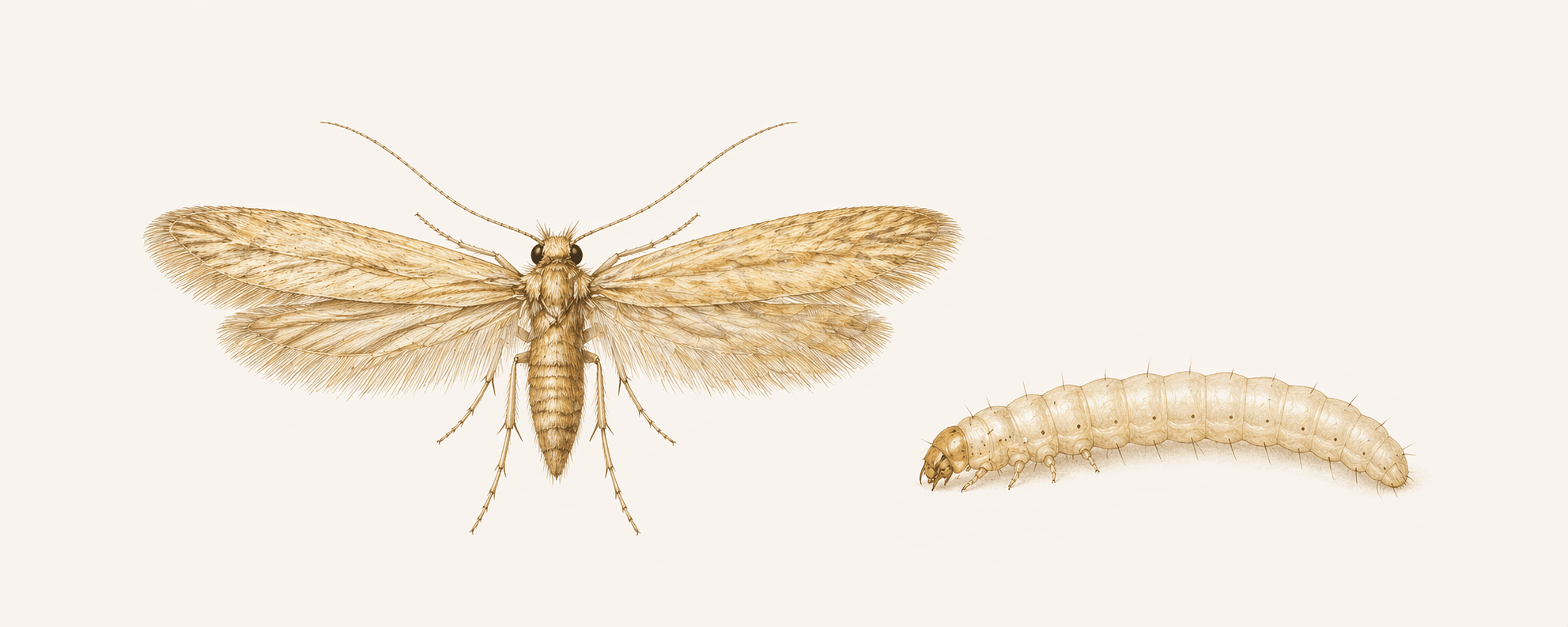
The clothes moth (Tineola bisselliella) remains invisible for a long time, which explains the often considerable extent of the damage by the time of diagnosis. The adult measures 6 to 8 mm, sports a uniform golden-beige colour with no pattern, and a characteristic fringe along the edge of the wings. Unlike the pantry moth, it shuns light and flies little; it is more often seen running across a wardrobe wall than flying across a room.
The signs that should raise the alarm:
- Small round or irregular holes in woollens, cashmeres and felts, particularly under armholes, on collars and in folds kept folded
- Worn patches or a "nibbled" appearance on rugs, the underside of sofa skirts and the padding of upholstered seats
- Silk threads woven into a tube stuck to the fibres, sometimes covered with textile particles
- Small white cocoons in wardrobe corners, on skirting-board mouldings, behind picture frames
- White larvae of 8 to 12 mm, with a brown head, mobile when disturbed
- Micro-droppings, dark, the colour of the ingested fabric, at the bottom of a drawer or in folds
A key point: the adult does not eat. Only the larva consumes keratin. Seeing a few moths flying therefore means that reproduction is already in full swing in a nearby textile.
Health and material risks
Unlike bed bugs or cockroaches, the clothes moth is not a direct health threat: it does not bite and does not transmit any pathogen. The risk shifts to two areas.
Material, often heavy. A cashmere coat, an oriental rug, vintage fur, an archived haute couture outfit, a vicuña throw can be destroyed within a few weeks. The damage is typically concentrated on rarely worn items, stored for a long time without movement — so, statistically, on the highest-value articles. Textile collections kept in Monaco and on the Côte often represent considerable sums, sometimes irreplaceable (bespoke pieces, discontinued fabrics, family heirlooms).
Allergic, secondary. Larval fragments, wing scales and micro-debris can worsen an asthmatic condition or rhinitis, particularly in children and people already sensitive to dust mites.
On the legal side, no specific obligation falls on the Monaco landlord for clothes moths (unlike bed bugs). However, a managing agent or the manager of a residential hotel has an interest in documenting every intervention: in a high-end environment, traceability protects against claims.
Why this pest thrives in Monaco and on the Riviera
Three factors combine in the Principality and its hinterland to create an ideal environment.
The Mediterranean climate. Moderate relative humidity and mild temperatures all year round, including inside air-conditioned homes, allow Tineola bisselliella to complete several annual cycles instead of just one. A dressing room at 22 °C all year, a cellar at 18 °C, a residential garage in Fontvieille: all favourable micro-climates.
The residential fabric. Monte-Carlo, La Condamine and Larvotto, but also Cap-d'Ail, Beausoleil, Roquebrune-Cap-Martin and Cap-Ferrat, concentrate a rare density of wardrobes made up of fine natural fibres: merino wool, cashmere, alpaca, silk, fur. These fibres are exactly the substrate the larva needs. Synthetic fibres, by contrast, are ignored — except when they are blended with wool.
The seasonality of use. Second homes closed for several months, alternating summer/winter wardrobes, rug collections rolled up out of season, yachts moored at Port Hercule whose carpets and curtains stay in place: periods of textile stillness are the exact window for an infestation to establish itself. A dressing room reopened in October after six months of closure is a classic scenario of late discovery.
The MPS protocol in five steps
- On-site diagnosis. Methodical inspection dressing room by dressing room, drawer by drawer, textile item by textile item. Installation of Tineola bisselliella pheromone traps to map the active hotspots and distinguish a residual infestation from an ongoing one. Collection of cocoons for species confirmation (clothes moth vs the tapestry moth Trichophaga tapetzella, whose strategy differs).
- Mechanical extraction. Deep vacuuming of infested areas with a HEPA filter: skirting boards, corners, drawer runners, undersides and backs of heavy furniture, the undersides of rugs. This step removes eggs, cocoons and micro-debris. No chemical substance in contact with fine textiles at this stage.
- Targeted contact treatment. Application of an authorised biocide exclusively on structural areas (wardrobe walls, skirting boards, wall cavities), never on worn or stored fabrics. Choice of active substance according to the substrate and the degree of infestation, within a measured-control logic.
- Monitoring. Pheromone traps kept in place for several weeks to confirm the extinction of the hotspot. A follow-up appointment is set after a complete development cycle.
- Certification and NDA. Detailed intervention report, under a systematic confidentiality agreement. MPS, Certibiocide N121134, RCI Monaco 26S10394, operates within a discreet contractual framework suited to private clients.
Mistakes to avoid
Certain instinctive reactions worsen the problem rather than solving it.
- The mothball or camphor block. Limited repellent effect and, above all, questionable health value in an enclosed space. Kills neither eggs nor larvae already in place.
- Supermarket-bought cedar. New cedar wood releases a volatile compound that loses its effect within a few months. A block forgotten for ten years in a dressing room has no effect at all.
- Lavender and essential oils. Useful as light prevention, of no curative value against an established infestation.
- The general-purpose household aerosol sprayed into a dressing room. It kills a few visible adults but leaves eggs and larvae intact, while impregnating the textiles.
- Washing at 30 °C. Insufficient. Keratin must be raised above 55 °C or frozen at −18 °C for several days to neutralise eggs and larvae.
- Postponing treatment. Since the moth has several annual cycles at our latitudes, a year's wait can turn one affected wardrobe into an entire floor.
A typical case: a top-garden flat, Monte-Carlo
The main residence of a couple, a high-floor flat in Monte-Carlo. Madame's dressing room, made up of several dozen cashmere and merino-wool pieces, is opened daily but includes a high, little-used area where winter outfits are stored. In autumn, several jumpers taken out show clean holes. Small beige moths are seen in the evening, in the adjoining corridor.
The MPS diagnosis revealed a primary hotspot in the high area — a pashmina shawl not worn for two winters serving as a feeding source — and a secondary hotspot in a wool rug under a rarely moved console. Complete HEPA vacuuming, contact treatment of the runners and skirting boards only, installation of three pheromone traps. Inspection at thirty days: no more captures. Inspection at sixty days: nil. Report and closure under NDA. No textile item left the flat, and no product was applied to worn textiles.
Lasting prevention
Once the hotspot is extinguished, the moth can return: the eggs travel easily (vintage purchases, an external dry-cleaner, rugs received, storage boxes). A few habits sharply limit the risk.
- Rotate the garments in the wardrobes; pieces left still for more than six months are the most exposed
- Clean before seasonal storage: the moth is attracted by organic traces (perspiration, perfume, saliva, food stains), even invisible ones
- Airtight garment covers for winter pieces stored in summer and vice versa; favour covers with a continuous zip closure
- Preventive freezing (−18 °C, several days) for pieces received second-hand or from third-party storage before adding them to the wardrobe
- Vacuum regularly the skirting boards, undersides of furniture, drawer runners and undersides of rugs
- A monitoring pheromone trap in a sensitive dressing room: detects a reinfestation before it becomes visible
For significant collections (antique rugs, furs, gala wardrobes), an annual inspection documented by a Certibiocide operator is the de facto standard on the Riviera.
Regulatory framework and professional service
The clothes moth is not classified as a public-order pest: neither France nor Monaco imposes compulsory treatment, unlike bed bugs in the hotel trade or cockroaches in HACCP kitchens. However, any biocidal treatment in the Principality must be carried out by a certified operator: this is the purpose of the Certibiocide certification, which MPS holds (N121134). The products used comply with the European and Monaco authorisations in force, with traceability by batch and by intervention.
The domestic use of "shock" products bought in supermarkets remains legal for a private individual, but does not meet the same safety requirement (choice of active substances, dosage, ventilation, protection of occupants and textiles). With a heritage clientele, the question is never just effectiveness: it is the guarantee that no textile item, artwork or decorative surface will be damaged by the treatment.
How long, how many visits
For an infestation localised to a dressing room or a single room, one main visit is generally sufficient, followed by an inspection at thirty and then sixty days to confirm the absence of any new flights captured. Complete resolution fits within a window of four to eight weeks, aligned with the larva's cycle.
For an extensive infestation (several rooms, multiple rugs, an entire residence left closed for a long time), two closely spaced visits are sometimes necessary, with extended follow-up. MPS costs each intervention after an on-site diagnosis, never blind over the telephone: it is the only way to guarantee an honest quote and a properly calibrated treatment.
In any doubt? Our team responds within 2 working hours. +377 37 70 70 02 — or [request a free quote](/devis-gratuit).