
Identifying flies: the signs that never lie
Three species dominate the clinical picture in Monaco and on the Riviera, and each announces itself differently.
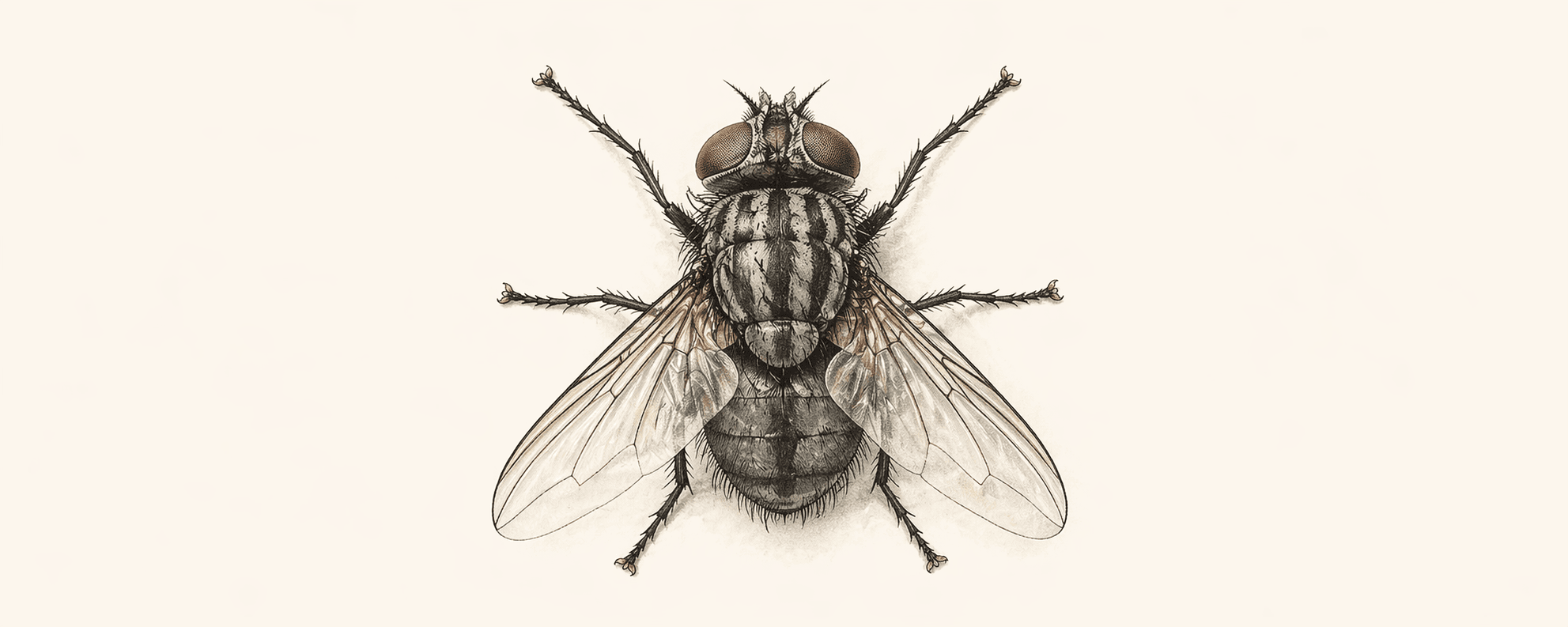
- *Musca domestica* (house fly): 6 to 8 mm, striped grey-brown, it flies in circles around light points and lands on every surface. Indirect signs: small black dots (droppings) and pale regurgitation marks on windows, ceiling lights and the tops of refrigerators.
- *Drosophila* (vinegar or fruit fly): 2 to 3 mm, red eyes, slow, hesitant flight. It betrays a fermentation source — ripe fruit, biologically fouled drains, wine left in a glass, damp tea towels.
- **Calliphora / Lucilia** (blowflies, metallic blue or green): 8 to 12 mm, noisy flight. Their presence almost always indicates decomposing organic matter nearby: a dead rodent in a service duct, a forgotten bin, a saturated grease trap.
The presence of maggots on tiling, in the joint of a bin store or under a skirting board is the most important warning signal: it indicates that a full life cycle has already established itself, often for several days.
Health and material risks
Flies do not bite — apart from Stomoxys, rare in urban areas — but they mechanically transport, on their legs and via their regurgitations, a whole array of pathogens: E. coli, Salmonella, Campylobacter, Shigella, as well as helminth eggs. For a restaurant on the Fontvieille harbour or a brasserie in Larvotto, a single fly visible in the dining room can be enough to trigger a customer complaint, a report, or even a non-conformity during an HACCP audit.
On the material side, the damage is modest but unsightly: black speck marks that are very difficult to clean from painted ceilings, period light fittings and the wall fabrics of Haussmann-style flats in Monte-Carlo.
On the legal side, a catering operator is subject to an obligation of sanitary results (the hygiene package and procedures based on HACCP principles). In a co-owned building, an infested bin store engages the managing agent's liability. In Monaco, inspections by the les autorités sanitaires monégasques are regular, and the absence of a documented control plan is an aggravating factor.
Why this pest thrives in Monaco and on the Riviera
The Mediterranean climate gives Musca domestica an activity season stretching from April to November, sometimes all year round in heated kitchens and plant rooms. An egg-to-adult cycle can be completed in seven to ten days in warm weather: a few untreated females are enough to generate a population of several hundred individuals in two to three weeks.
Monaco's urban density concentrates the attraction factors: street-front restaurants at Port Hercule, the markets of La Condamine, the beaches of Larvotto, tree-shaded terraces in Cap-d'Ail and Roquebrune. Moored yachts, with their compact waste bins, are particularly dreaded localised hotspots at the height of the season. Further back, the high-end residential fabric — villas with gardens, swimming pools, compost — offers the fruit fly and blowflies a variety of micro-habitats that routine cleaning does not always reach (floor drains, inspection chambers, pergola gutters).
The MPS protocol in five steps
- On-site diagnosis — A Certibiocide N121134 technician identifies the species, maps the larval breeding sites and adult resting areas, measures the pressure through counts and, in catering, cross-references with the existing HACCP plan.
- Correcting the sources — Before any biocide, MPS lists the priority non-chemical actions: sealing of bins, purging of drain traps, cleaning of grease traps, insect screens, strip curtains, delivery management.
- Physical trapping — Installation of UV light traps with glue boards (never electrocution models in food areas, to avoid the projection of insect fragments) in service and back-of-house areas. Positioned at the appropriate height, out of customers' sight lines.
- Targeted treatment — Application of bait gel on removable supports away from food surfaces, contact treatment of resting areas (door frames, bin store ceilings). Biocidal fogging only in cases of acute infestation, with no people present, with a documented re-entry time.
- Inspection and certification — Follow-up visit within 10 to 15 days, trap checks, adjustment, delivery of a signed report with full traceability of the products used (marketing authorisation numbers, dates, operator).
Mistakes to avoid
Private individuals and establishment managers often undermine their own efforts through intuitive but counter-productive reflexes.
- Consumer insecticide sprays kill the visible adults but leave eggs, larvae and pupae intact: the population rebounds within days, often resistant.
- Sticky ribbons in a restaurant dining room are perceived as a negative signal by customers and do not tackle the source.
- Pouring boiling water or vinegar down drain traps against fruit flies only removes the surface film: the biofilm on the pipe walls persists.
- Electrocution light traps are prohibited in food environments — they project contaminating micro-fragments.
- Confusing fruit flies with fungus gnats (the midge of indoor plants) leads to treating the kitchen when the source is an orange tree pot on the terrace.
Effective control starts with correct identification, not with a product.
A typical case: a beach restaurant in Fontvieille
At the end of June, a quayside restaurant reported growing nuisance at the end of service. The MPS diagnosis identified three concurrent hotspots: Musca domestica attracted by the poorly ventilated bin store, fruit flies established in the bar's drain trap (a biofilm of syrups) and sporadic blowflies around the non-airtight outdoor grease trap.
The action plan combined an enzymatic purge of the pipework, replacement of the grease-trap seals, the installation of two UV glue-board light traps (back kitchen + dishwashing room) and a targeted gel treatment. Two visits a fortnight apart, and a third inspection visit at the height of the season. The whole job was carried out under NDA, outside opening hours, with a photographic report delivered to the HACCP manager.
Lasting prevention
Prevention is the best biocide. A few habits build in lasting resistance:
- Closed bins, emptied daily, double-bagged, bin stores ventilated and pressure-washed once a week.
- Monthly drain-trap maintenance (mechanical rodding + enzyme, no bleach, which merely displaces the problem).
- Insect screens on west- and south-facing windows, PVC strip curtains in professional kitchens.
- Composters kept away from openings, turned regularly, never left open.
- Weekly visual check of ceiling lights, pendant fittings and pipework: speck marks appear before the infestation becomes visible.
For sensitive establishments, MPS offers a seasonal monitoring contract with quarterly trap checks and a trend report.
Regulatory framework in Monaco
The practice of pest control in Monaco is regulated: use of Certibiocide-compliant biocides, traceability of the products applied, observance of re-entry times. In catering, Monegasque regulations require an approach based on HACCP principles that explicitly includes pest control; the absence of a documented rodent and insect control contract is regularly noted during inspections. Monaco Pest Solutions, RCI 26S10394, delivers with every intervention the admissible documents (report, safety data sheets, trapping plan) required by an auditor or the administration.
How long, how many visits
For a simple domestic infestation — a few house flies attracted by a forgotten dish, a fruit fly from ripe fruit — one visit is sufficient in the majority of cases, with a visible effect within 24 to 72 hours.
For an established infestation in a restaurant or co-owned building — an active larval hotspot, several species, high summer — allow generally two to three visits spread over three to four weeks: initial intervention, interim inspection, closing visit. The visible disappearance of adults happens quickly; the complete collapse of the cycle requires covering a full generation.
Season-long follow-up (April-October) is recommended for establishments open to the outdoors, yachts on extended stopovers and co-owned buildings with ground-floor catering.
In any doubt? Our team responds within 2 working hours. +377 37 70 70 02 — or [request a free quote](/devis-gratuit).