
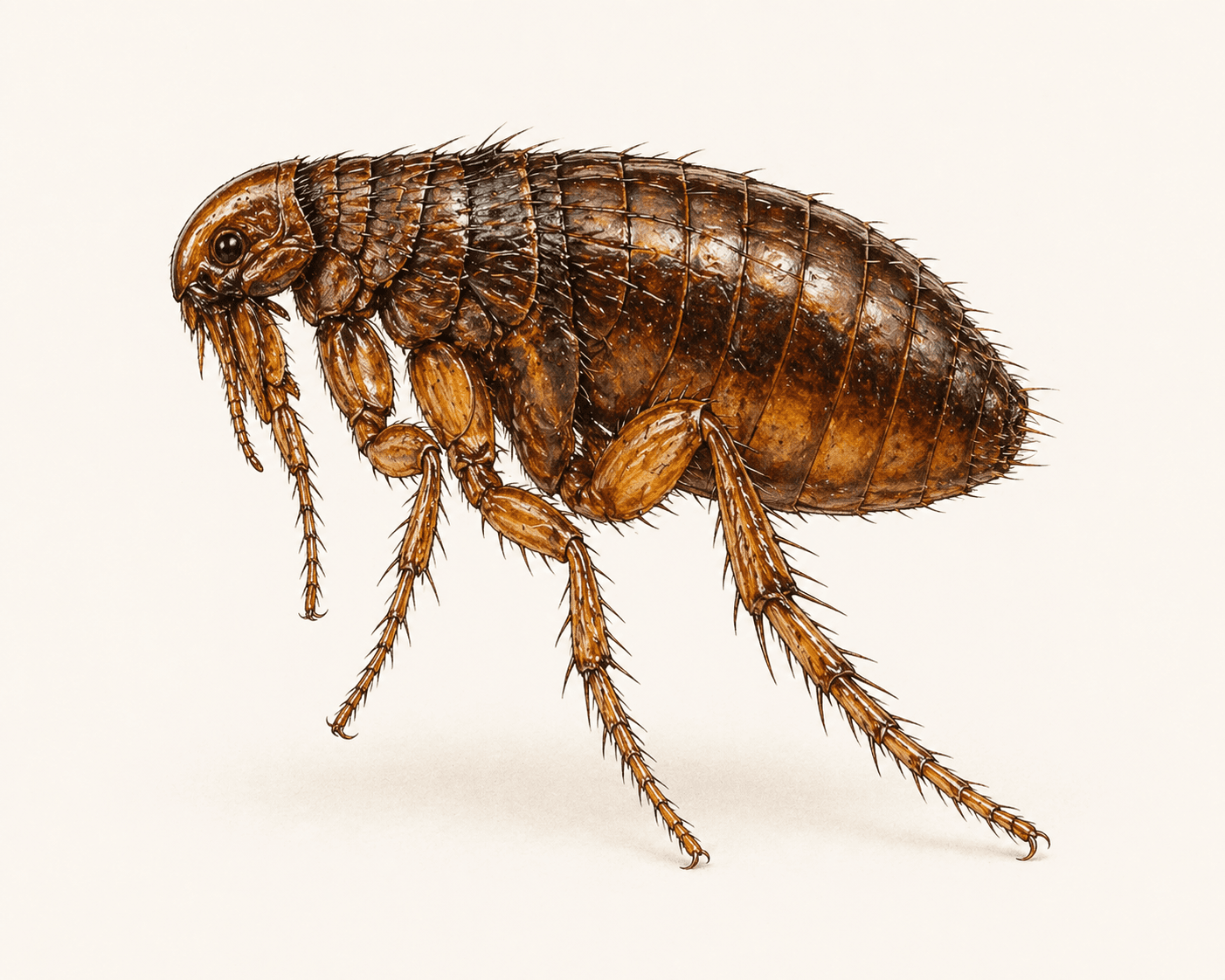
Identifying fleas: the signs that never lie
The adult flea measures between 1.5 and 3 mm, reddish-brown, with a body flattened sideways to slip between hairs, and powerful hind legs that allow it dizzying jumps relative to its size. Impossible to crush between two fingers: it slips away. The obvious signs remain rare — you will more likely see the indirect clues:
- Human bites grouped in 2s or 3s, often on the ankles, calves and lower leg, with an itchy red central spot
- A pet nibbling itself at the base of the tail, the groin or the inner thighs
- Granular black dots in the coat, on baskets, light-coloured rugs and sofas: these are flea droppings, which turn red in water (digested blood)
- Pearly white eggs of 0.5 mm, slippery, which fall from the animals to the floor
- Whitish worm-like larvae at the bottom of textiles, under skirting boards, in parquet grooves
A simple test: walk in white socks through the suspect areas for around ten minutes. The adult fleas move up towards the warmth and are clearly visible on the light-coloured fabric. If in doubt, a professional diagnosis confirms the species and scale.
Health and material risks
The flea is not just a nuisance. Its bites cause flea-bite dermatitis (FAD), a common allergic reaction in dogs and cats, with hair loss and secondary infections. In sensitive humans or children, the inflammation can develop into persistent itchy patches.
On the health side, the flea remains a historic vector:
- Possible transmission of the dog tapeworm (Dipylidium caninum) through accidental ingestion
- A documented role in the circulation of certain bartonelloses
- A reservoir of secondary pathogens in the presence of other pests (rodents in particular)
On the material side, the infestation progressively degrades baskets, carpets, natural-fibre rugs and upholstery. Poorly conducted steam cleaning can hatch the eggs without destroying them, worsening the hotspot.
On the legal side, a Monaco landlord must provide a dwelling free of pests within the meaning of the local tenancy rules. A hotel or a boarding kennel engages its liability in the event of a hygiene failing. Catering establishments that accept animals fall under indirect HACCP obligations when a hotspot contaminates the reception areas.
Why this pest thrives in Monaco and on the Riviera
The mild, humid Mediterranean climate, with winters rarely below 8-10 °C in heated interiors, offers Ctenocephalides ideal conditions all year round. The larval cycle, which requires 20 to 30 °C and humidity of 50 to 80%, proceeds without interruption on the Côte.
The Principality combines several aggravating factors:
- Residential density with very present pets, from the La Condamine studio to the Larvotto villas
- International movement of animals via Port Hercule and the local airport infrastructure, regularly bringing in resistant strains
- Growing pet-friendly hotel trade, particularly in Monte-Carlo, Cap-d'Ail and Beausoleil
- Older co-owned buildings in the Old Town and Fontvieille with parquet, thick carpets and favourable crevices
- Gardens and terraces where hedgehogs, free-roaming cats and small mammals regularly reintroduce fleas
The hinterland — Roquebrune-Cap-Martin, La Turbie, Èze — combines dense vegetation and wildlife, which feeds a permanent pressure on second homes. The classic seasonality (May-October peak) fades: in Monaco, winter hotspots are common in heated interiors.
The MPS protocol in 4 steps
1. Entomological diagnosis. The MPS technician inspects animal sleeping areas, textiles, skirting boards, rugs, carpets, parquet and under furniture. White-sock test, sampling of droppings, species identification, mapping of active hotspots and location of at-risk areas (gardens, terraces, stairwells).
2. Deep professional vacuuming. A non-negotiable step, often neglected. High-power mechanical vacuuming extracts eggs, larvae and droppings, but above all stimulates the emergence of the pupae protected in their silken cocoon — without this trigger, no biocide can reach them. The bags are sealed and removed immediately.
3. Combined biocidal treatment. Application of an approved adulticide (pyrethroid or neonicotinoid depending on context) on textiles, floors and skirting boards, combined with an insect growth regulator (IGR) of the pyriproxyfen or methoprene type, which blocks the larva-to-pupa transition for several months. This combination breaks the cycle and prevents the rebound.
4. Inspection and certification. Inspection visit at 15-21 days, adjustment if necessary, delivery of a detailed intervention certificate. Monaco Pest Solutions covers the Principality, Cap-d'Ail, Beausoleil, Menton, Cap-Ferrat and the hinterland.
Mistakes to avoid
Consumer treatments fail most of the time because they ignore the complete cycle:
- Off-the-shelf aerosol sprays: hit the adults at the time, reach neither eggs nor pupal cocoons, with a guaranteed rebound at 3 weeks
- Collars or spot-ons alone on the animal: protect the animal but leave the environment contaminated
- Poorly calibrated steam cleaning: below a sustained 100 °C, you dampen without destroying, and make things worse
- Diatomaceous earth applied blind: can work on precise spots, ineffective on a massive hotspot, with respiratory risks
- Essential oils (lavender, cedar): partial repellent effect, no lethal effect on the protected stages
- Throwing out the rugs without treating the rest: the pupae migrate to the skirting boards
- Ignoring the vehicle or the second home where the animal has stayed
The most costly mistake: treating without deep vacuuming first. Without this mechanical trigger, up to half the population remains dormant and restarts the cycle two months later.
A typical Monaco case
A villa with a garden in Roquebrune-Cap-Martin, three indoor-outdoor cats, discreet household staff. Bites noticed by the children on their return from holiday, one cat visibly weakened. The owners had tried two pharmacy treatments and a steam pass before calling.
MPS diagnosis: a primary hotspot in the pool house (a linen sofa, a Berber rug), a secondary hotspot in the laundry near the baskets, light contamination of the main lounge. The cycle in full activity, a marked presence of dormant pupae.
Intervention in two stages: professional vacuuming of the 180 m² concerned (including furniture lifted and dismantled), adulticide + IGR treatment targeted on the mapped areas, coordination with the vet for simultaneous treatment of the three cats, refurbishment of the baskets with new textiles. Inspection visit at 18 days, no residual activity. The whole service was carried out under NDA, with discretion towards the staff present.
The key point: without the animal + environment coordination, the hotspot would have returned within six weeks.
Lasting prevention
After treatment, a few regular habits prevent re-establishment:
- Weekly vacuuming at minimum of sleeping areas, rugs and sofas, paying attention to grooves and under furniture
- Washing at 60 °C of the animals' baskets, throws and cushions every two weeks
- Up-to-date veterinary flea treatment on all animals in the household, coordinated between them (one untreated animal maintains the cycle)
- Control of access points: cat flaps, terraces, gardens where hedgehogs or outdoor cats pass
- Inspection of returns from a stay, a boarding kennel, a grooming session: the flea travels
- Annual preventive treatment in high-pressure areas (villas with gardens, pet-friendly hotels)
For second homes that are often empty, a check before reopening avoids the nasty surprise: the pupal cocoons survive several months without a host and activate at the first human vibration.
Regulatory framework
The biocides used against fleas fall, in France, under the European framework for professional biocides (BPR), with a Certibiocide approval obligation for the professional applicator. Monaco Pest Solutions holds the Certibiocide approval N121134 and applies exclusively authorised, dosed and traced active substances.
In Monaco, the regulations largely align with European standards while imposing their own requirements regarding the hygiene of premises open to the public, applicable to hotels, restaurants, serviced residences and co-owned buildings. A landlord must provide a decent dwelling, free of proven pests.
The HACCP framework indirectly concerns any catering establishment where animals and clientele coexist: the flea can migrate to the reception areas and trigger a documentary failing. MPS systematically delivers an intervention certificate usable in an audit.
How long, how many visits
A flea infestation is generally resolved in two to three weeks from the intervention. A single visit is sufficient in the majority of well-prepared domestic settings (treated animal, accessible textiles, vacuuming carried out beforehand). A second visit becomes necessary when several hotspots coexist, in the case of a multi-level villa with a garden, or when late pupal cocoons emerge.
The inspection visit at 15-21 days is an integral part of the MPS protocol and allows adjustment at no extra cost if necessary. The feeling of a "rebound" three weeks after the intervention almost always reflects the normal emergence of cocoons, neutralised by the IGR already in place. Any genuine residual activity is dealt with.
In any doubt? Our team responds within 2 working hours. +377 37 70 70 02 — or [request a free quote](/devis-gratuit).